Science & Technology
NISAR Satellite Finds Earth, Still Missing Your Keys
NISAR Satellite scans almost all land and ice twice every 12 days, making household disorganisation an international challenge.
Showing 1 to 12 of 16 articles
NISAR Satellite scans almost all land and ice twice every 12 days, making household disorganisation an international challenge.
Mars Rover Curiosity took fifteen images during an orbiter call, setting a productivity target nobody on Earth requested.
The Outer Space Committee has discussed peaceful cooperation, while Earth waited outside with several wars and a laminated visitor pass.
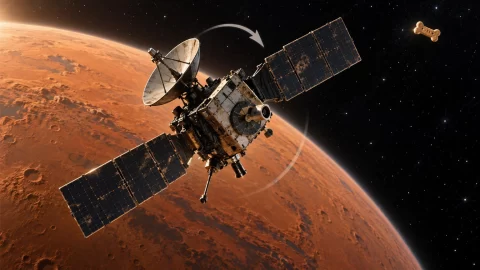
A Mars orbiter performs a 120 degree roll to sharpen its underground radar, proving the oldest thing in space still has more agility than the rest of us.
The Royal Observatory celebrates 350 years of measuring time precisely while Britain continues arriving whenever the replacement bus permits.
The alien life search has reached its most advanced phase yet: asking the research community to comment on 60 documents before the deadline.
A Mars dust devil has photobombed Perseverance's 1,500-sol selfie, proving unwanted background guests now operate across planets.
A dusty Mars magnet has received a close inspection from Curiosity, proving even another planet cannot escape a highly specific cleaning audit.
Venus crust may control its thickness by melting or shedding dense material, a geological strategy familiar to anyone avoiding attic storage.
A clear atmosphere surrounds this hot sub-Neptune, although tourism officials remain quiet about the water vapour and 1,340-degree heat.
Formation flying spacecraft found each other with a laser after trying the orbital equivalent of standing by the trolley bay.
Small satellites face a large universe, a tiny budget and the annual expectation that an intern can explain dark matter by lunch.