
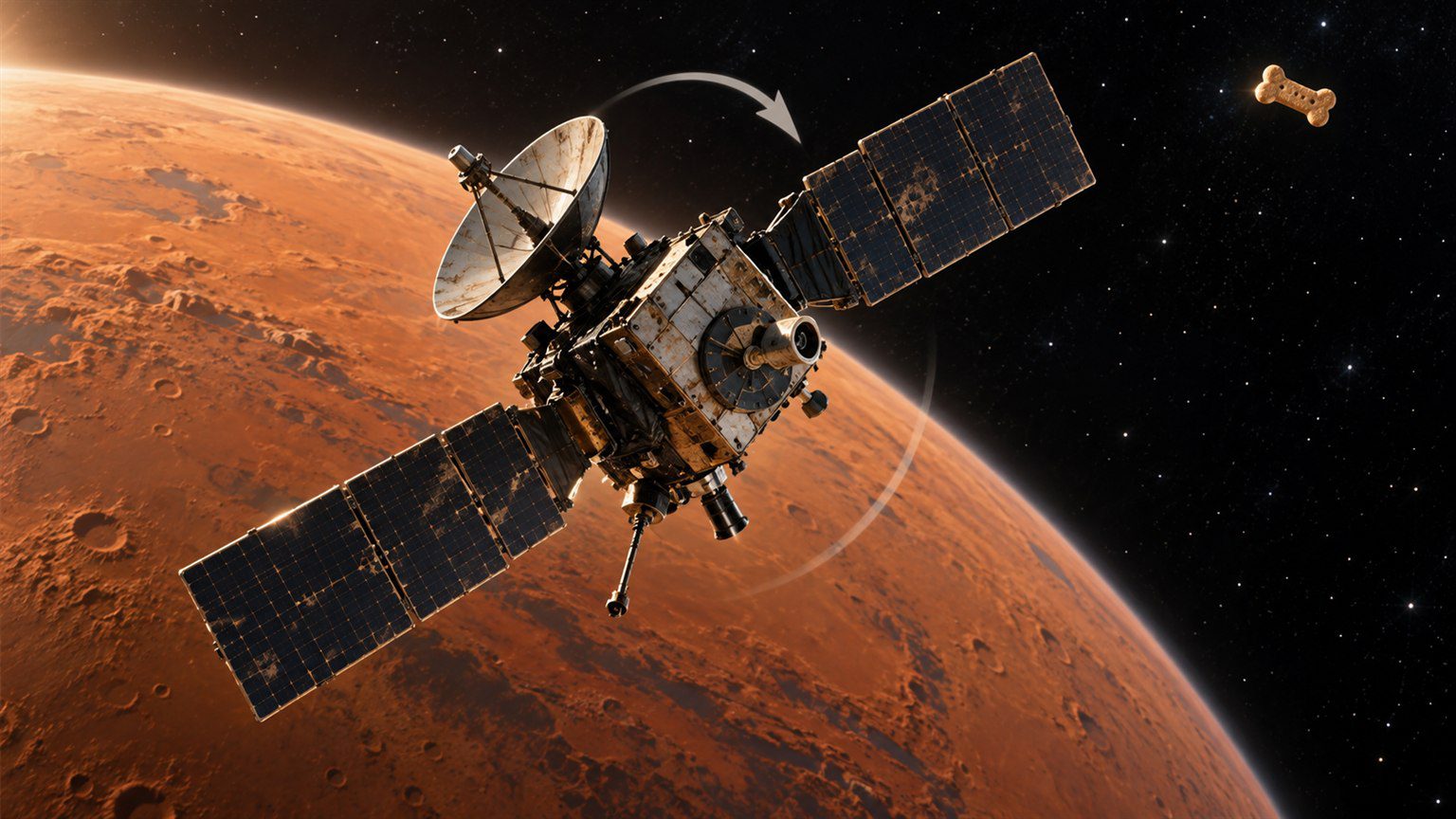
Mars orbiter learns another expensive trick
Mars orbiter Mars Reconnaissance Orbiter has learned a 120 degree roll. It took almost twenty years. It is now more adaptable than every office printer that has ever declared a paper jam and then retired from public life.
NASA adapted the manoeuvre for its SHARAD radar. The roll lets the radar look deeper below the Martian surface. NASA says the signal can become at least ten times stronger. This is good news for anyone hoping to find water on Mars. It is bad news for the billionaire who thought Mars was an empty plot awaiting a tasteful glass box.
Usually, the spacecraft rolls by no more than 30 degrees. However, the larger movement avoids interference from other parts of the orbiter. In practical terms, it has learned that moving your head away from the WiFi router sometimes helps.
Each roll takes weeks of planning. Power, communications and instrument safety all matter. The Mars orbiter therefore has a more rigorous turning over procedure than most people facing a Monday alarm, a damp towel and a career in middle management.
Meanwhile, the radar is searching for liquid and frozen water beneath Mars. Another instrument now uses ordinary rolls because its moving mount has become unreliable. On Earth, this is called covering Barry’s duties until someone remembers Barry has gone.
Finally, the spacecraft sent back clearer data. It then resumed orbiting a planet with no pubs, no atmosphere and apparently no biscuits. With enough public money, even the oldest machine can learn a new trick. Just do not ask it to fill in a password reset form.
Read the real story: NASA’s report on the Mars Reconnaissance Orbiter’s new manoeuvre.