NISAR Satellite starts checking the whole planet
NISAR Satellite can scan nearly all Earth’s land and ice twice every 12 days. Humanity can now inspect a planet in remarkable detail while still failing to locate the glasses currently conducting the search.
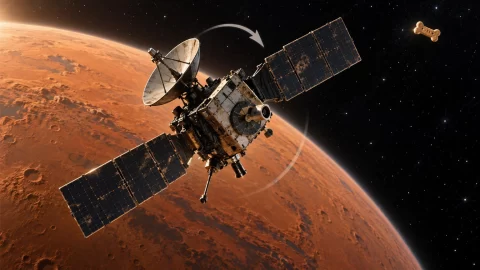
NASA and ISRO run the mission together. The spacecraft circles Earth 14 times each day. It is now the most diligent employee ever asked whether anything has moved since the previous meeting.
Its radar tracks changes in land and ice. It can support research into earthquakes, landslides, volcanoes and changing terrain. It can detect movement in centimetres, but it has wisely declined to settle who put the scissors in the wrong drawer.
Earth receives a polite inspection notice
“No surface escapes the schedule,” said Dr Radar McOrbit, Chief Inspector of Continents. “Antarctica should ensure access between nine and twelve, weather permitting and weather never permitting.”
Radar can work through cloud and darkness. Britain particularly welcomes this feature. A mission that required clear daylight would complete national coverage on one optimistic Thursday in May.
The data can help researchers understand hazards and monitor change. Councils have asked whether it can spot subsidence before a road cone arrives, obtains planning permission and starts a family.
Every twelve days the survey begins again. Earth has promised to tidy up. It will hide loose oceans in a cupboard and explain that the volcano is generally quieter when guests are absent.
The continental inventory has notes
Early results may show moving ice and shifting land. The NISAR Satellite has also noted several unsecured coastlines, one continent drifting without authorisation and a troubling amount of Australia that appears to face the wrong way on the diagram.
Earth is not expected to respond at once. It will first need to find the email, recover the password and confirm that it is not a robot, which should take roughly one geological era.
Read the real story: NASA’s overview of the joint NISAR mission.