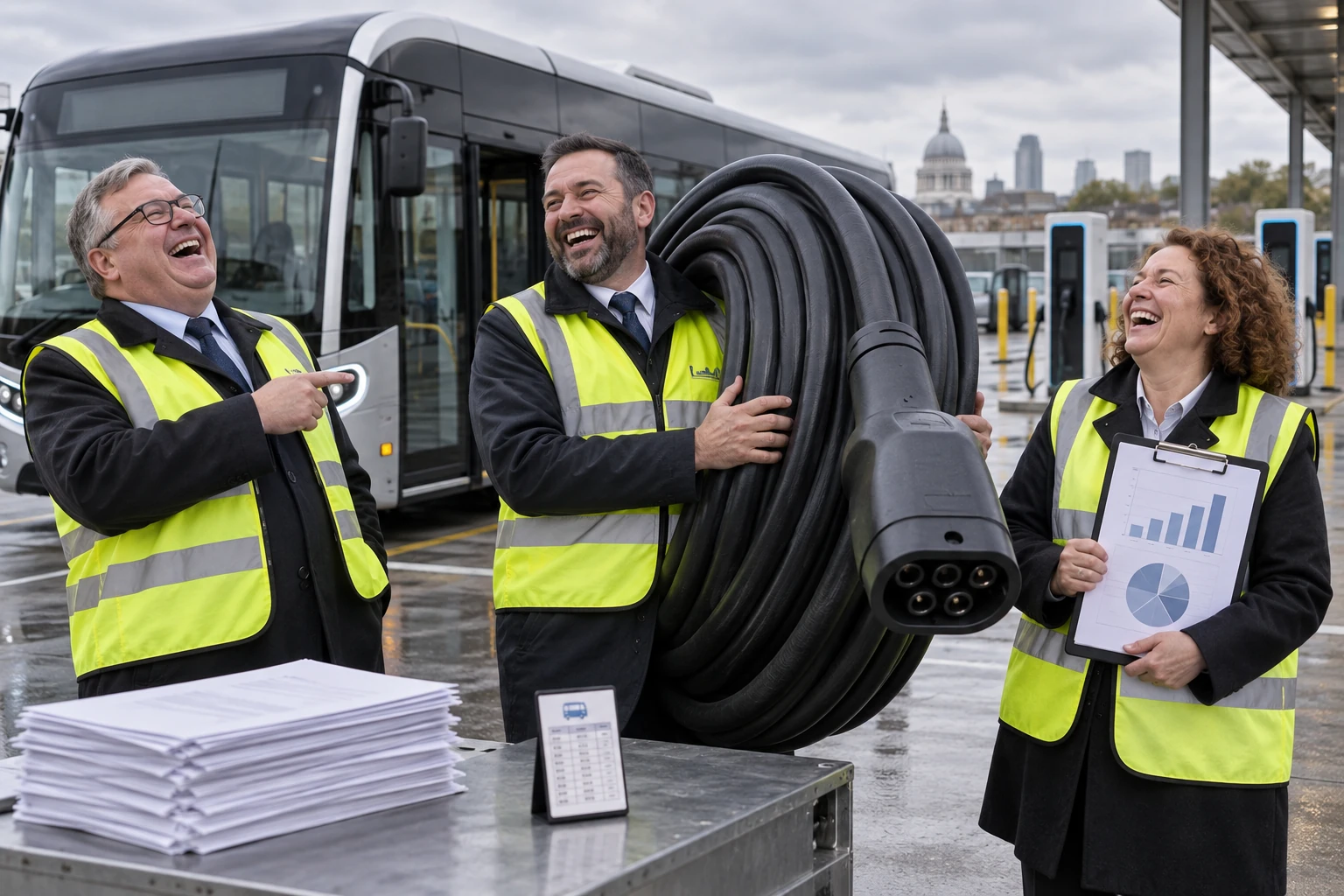
Zero emission bus funding has given 319 buses permission to become quieter, cleaner and briefly more important than every cabinet minister who has ever posed beside a charging point.
The Department for Transport is putting £37.8 million into 319 zero emission buses for 12 English local authorities. The buses are expected to serve passengers by spring 2027, while every pound of public funding is set to attract at least £3 in private investment. Apparently, even a bus now needs a business plan before it can leave the kerb.
The new vehicles should bring smoother, quieter journeys. That matters. For years, passengers have enjoyed the scenery through the soundtrack of a metal wardrobe falling downstairs. The Department of Muffled Engine Noises can now present silence as a customer benefit rather than the alarming absence of a diesel rattle.
Fennel Grout, Deputy Director of Audible Progress, explained that people had asked for cleaner transport. The department listened, then produced a chart showing that the bus was also a jobs strategy, an industrial strategy and, in one draft, a morale lighthouse.
The funding will support the infrastructure needed to operate the buses. That is the practical part. However, the announcement has persuaded a battery to call itself transformational while it plugs into a depot wall. Buses need routes, drivers and passengers. None of those have asked to become a cross sector outcome.
The 12 local authorities can use the investment to improve ordinary journeys, including services connecting people to hospitals and universities. Consequently, the launch team has produced a brochure in which a timetable appears once, between six photographs of a cable and a paragraph about regional growth.
The private investment target has given the buses a financial personality. Each vehicle now arrives with a public pound in one hand, three hoped for private pounds in the other and an adviser explaining that this is not technically begging.
At the launch, the first silent bus made no speech at all. Officials praised its communications strategy, then asked whether it could be repurposed as a vision. It had already achieved the most ambitious transport target of the year: carrying passengers without carrying on.
Real story: Department for Transport.