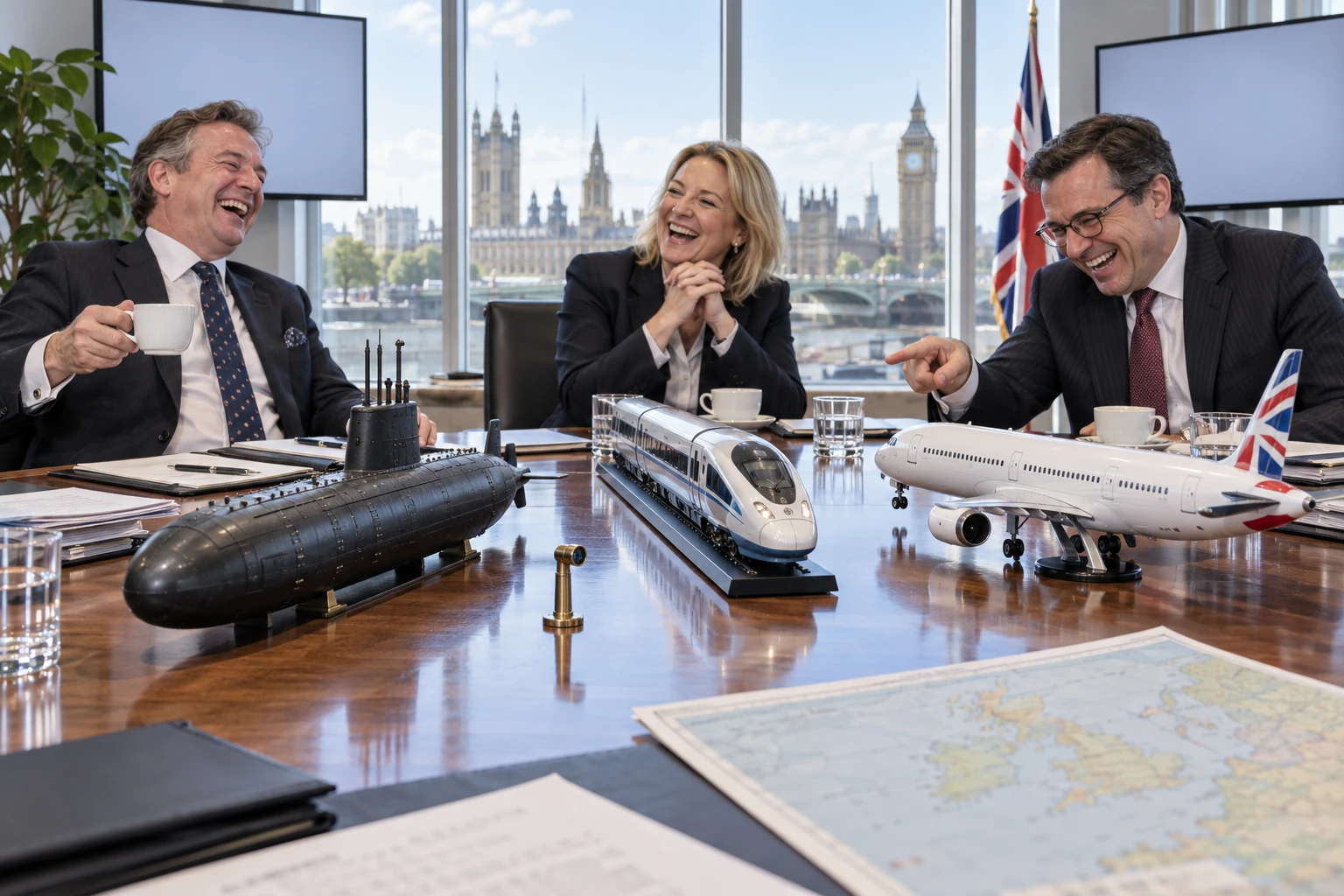
Britain has assembled trains, planes and submarines into one £400 million export story, proving that the national transport strategy is now less about getting anywhere than finding a meeting room large enough for the equipment.
The deals were announced around the G20 summit in South Africa and involve several kinds of British expertise. Crossrail International will provide strategic advice on South African railways. Rolls Royce will supply and service engines for ten Air Algérie aircraft in a package worth £370 million. Babcock will help assess the operational readiness of South African Type 209 submarines and carry out deep maintenance on at least one.
It is an impressive spread of wheels, wings and stealth. The government has opened a trade brochure and selected every item except a sensible explanation of what they have in common. The brochure may also contain a page about insurance, education and financial services, but the submarine has hidden it.
At the Office of Multimodal Handshakes, export envoy Nigel Platform said the package showed Britain could support transport “at every stage of the journey, including the bit where passengers lose confidence and start reading the safety card”. He then attempted to demonstrate cooperation between sectors by asking a railway consultant to service a jet engine. The consultant has been given a map, a biscuit and a quiet room.
The railway work is intended to help attract investment and improve passenger and freight services. British Steel is also supplying rail products to Türkiye’s high speed network, while a separate partnership will support digital changes to Vietnam’s railways. This is the serious part of the announcement. It involves engineering, consultancy and specialist work that cannot be replaced by a minister pointing at a graph until the graph becomes patriotic.
The aviation agreement offers another lesson. An aircraft requires engines, maintenance and a supply chain. It cannot run on optimism, mission statements or a photograph of someone shaking hands beside a factory. The photograph is still expected to travel further than the aircraft.
Trade analyst Brenda Wake welcomed the range. “A strong export package should have something for everyone,” she said. “If you dislike rail, there is aviation. If you dislike aviation, there is a submarine. If you dislike submarines, it is already too late to complain.”
The wider agreements are designed to reduce trade friction and create opportunities for British companies. That means the true national achievement may be making a submarine part of a conversation about paperwork. Somewhere in the G20, a customs official is being asked to tick a box marked “underwater” while insisting the process is perfectly straightforward.
Britain has finally built a joined up transport policy. The train carries the consultants, the plane carries the engines and the submarine carries the procurement team beneath the surface, where nobody can ask whether the refreshments are value for money. The biscuits have been classified as strategic assets.