Airbus has opened a space business launchpad in Stevenage with £3.9 million from the UK Space Agency, giving start ups laboratories, desks and a no cost residency programme. At last, a place where a prototype can fail at escape velocity without being asked to leave a café after two hours.
The Airbus Launchpad can accommodate more than 50 people and is intended to strengthen Britain’s space supply chain. One founder has already supplied a chain, a globe and a slide deck titled “Moon, But Faster”. The globe remains the most reliable part of the business, largely because nobody has asked it to demonstrate scalability.
The facility will give small firms and research organisations access to equipment, testing facilities and expertise they could not easily build alone. Professor Mavis Thruster of the Bureau of Very Small Satellites welcomed the arrangement. “Innovation needs room,” she said. “It also needs a cupboard where nobody stores a sandwich beside the vacuum chamber.”
Start ups will be able to use the site for research, testing and development. That is serious work. Yet one team has already spent an afternoon debating whether its office plant qualifies as payload after leaning slightly towards the window. The plant has since been promoted to head of orbital strategy.
The scheme forms part of Airbus’s Community for Space Prosperity programme, a name so optimistic that it appears to have been issued its own launch sequence. A committee has proposed sending prosperity into orbit from a rail near the ceiling. Engineers have suggested starting with a shelf, preferably one that has passed basic testing.
The UK Space Agency funding comes through the Space Clusters Infrastructure Fund and has been match funded by Airbus. It joins other facilities intended to support the sector, giving Britain more places to build complicated things before someone describes them as disruptive at a networking breakfast. The phrase has already been placed in a secure container.
Chief orbital clerk Bernard Clipboard praised the shared workspace. “A start up can now meet an investor without pretending a coffee shop is mission control,” he said. “That is progress, provided nobody orders oat milk near the instruments.” The coffee machine has requested a seat on the investment committee.
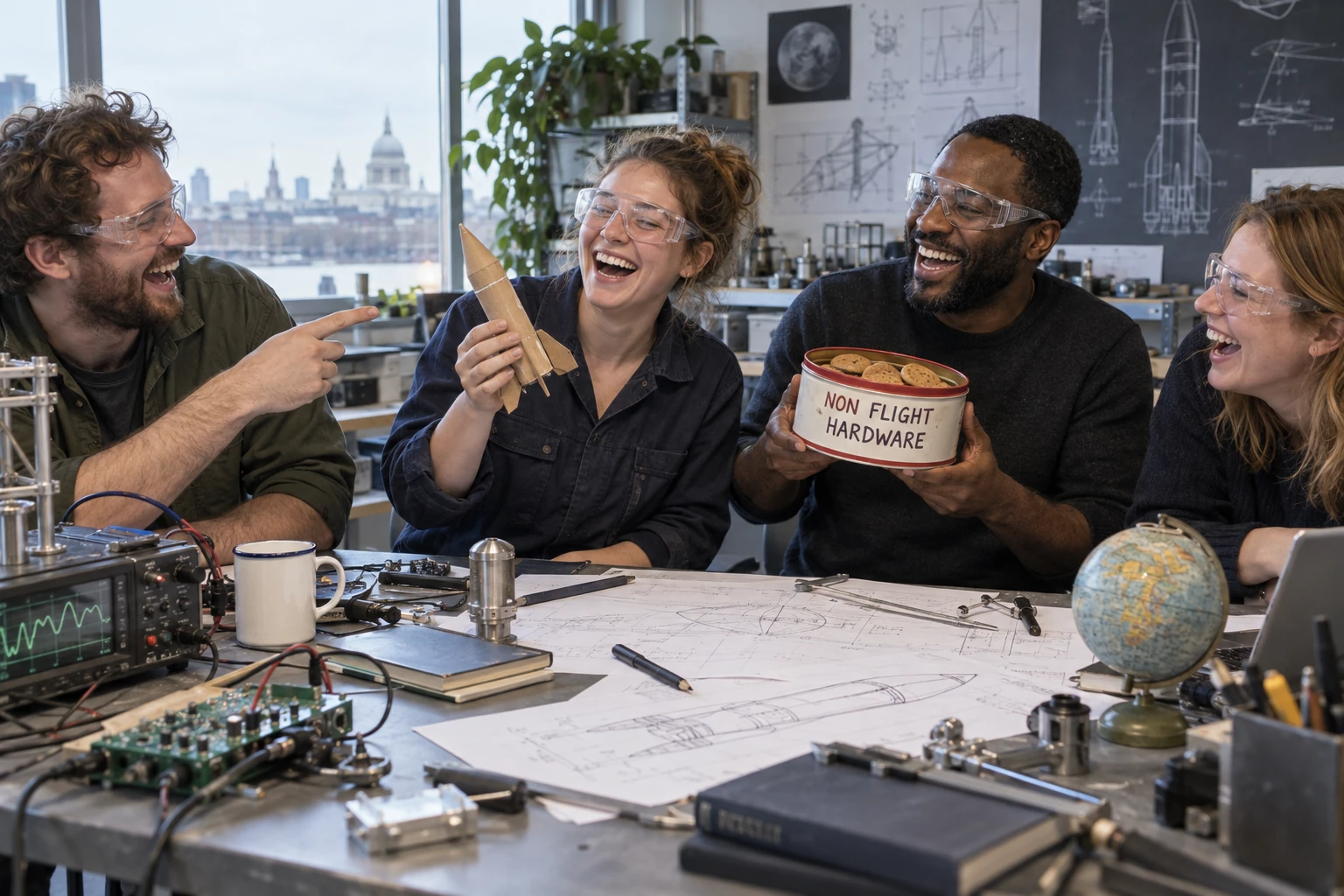
The launchpad cannot guarantee that every idea will reach orbit. It can offer equipment, expertise and somewhere to fail with dignity, which in technology is increasingly marketed as a premium service. By lunchtime, the first firm had tested a sensor, met a potential partner and labelled a biscuit tin “non flight hardware”.
The tin has accepted the decision with professional disappointment and is now seeking £3.9 million to diversify its supply chain. Its pitch deck begins, “A biscuit tin for every moon,” which means the space sector has finally found a container capable of holding all its ambition.
Source: UK Space Agency.