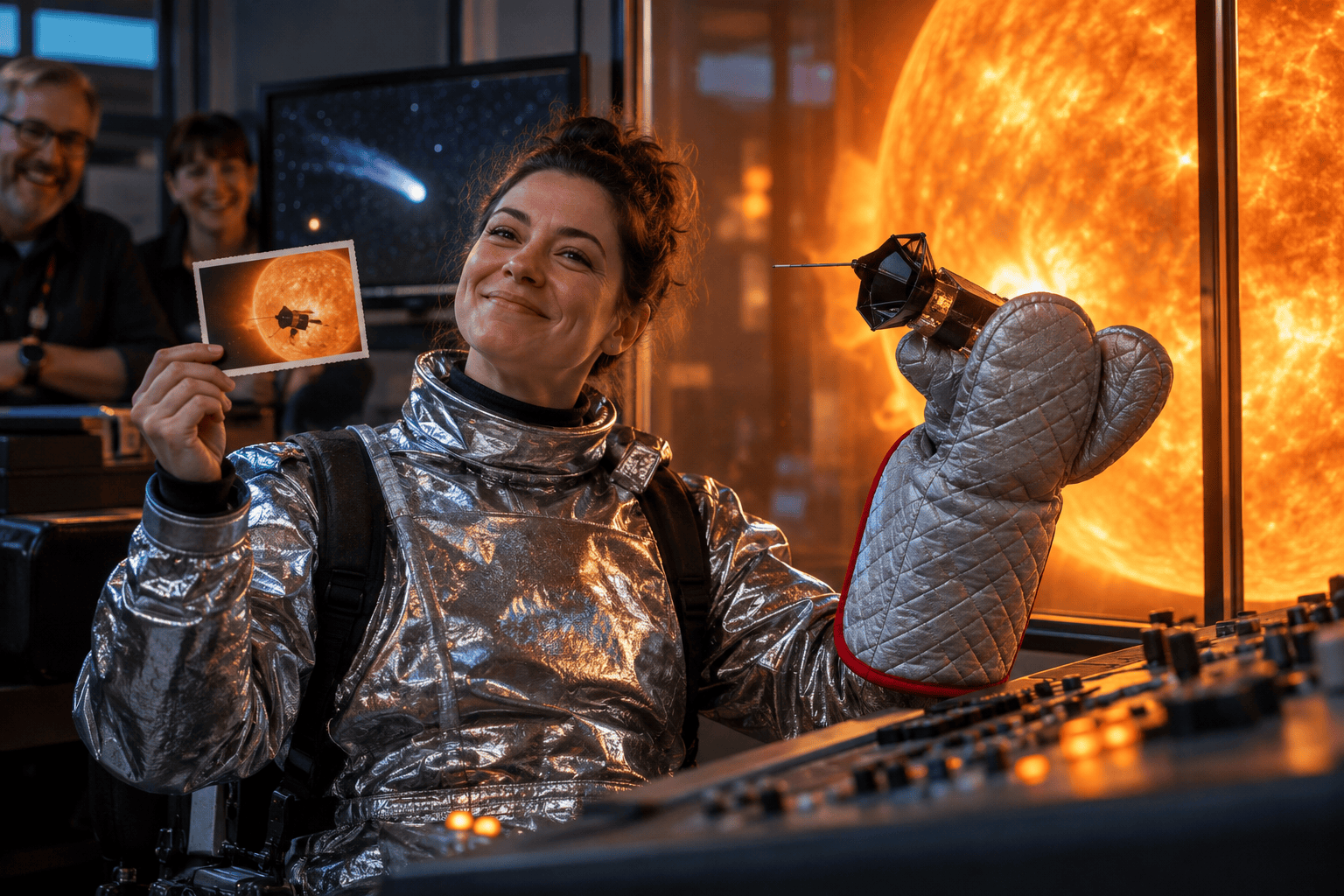
Parker Solar Probe has sent back a holiday video from inside Mercury’s orbit, showing six planets, a comet and the exact point at which “off the beaten track” becomes an insurance exclusion.
NASA sent the craft close to the Sun to study space weather. Britain has instead spotted a chance to get hotter than a Tenerife airport queue while avoiding the worst part of any trip: other British holidaymakers.
The footage contains coronal streamers, a small solar eruption and high energy particles. This is the nearest the Sun gets to entertainment. There is no pool, no breakfast buffet and no man from Leeds claiming he knows the owner. Yet it offers what every brochure promises: a place where nobody can hear the children.
The brochure nobody requested
Nigel Chafing, chief booking officer at Last Minute Oblivion, said: “The views are exceptional. You see Mercury, Venus, Saturn, Earth, Mars and Jupiter. The only disappointment is that the transfer from the airport takes the rest of your life.”
Earth appears briefly in the film, an attractive blue pebble where people hold emergency meetings because someone left the office radiator on. From close to the Sun it looks peaceful, largely because its complaints have not yet arrived.
Comet Tsuchinshan ATLAS then glides across the picture with the confidence of a celebrity who has told everyone not to make a fuss. Parker has now seen every familiar holiday ritual apart from an adult arguing with a teenager because the hotel WiFi does not work in space.
NASA will use the data to protect satellites and power grids from solar storms. The travel industry will use it to remind customers that if the weather was too hot, too bright and permanently lethal, they should have booked through an app.
The Sun has no beach, no shade and no return transfer. But it does have a corona. Experts confirm it has been pouring them over Earth for billions of years, which is more than can be said for the average all inclusive.