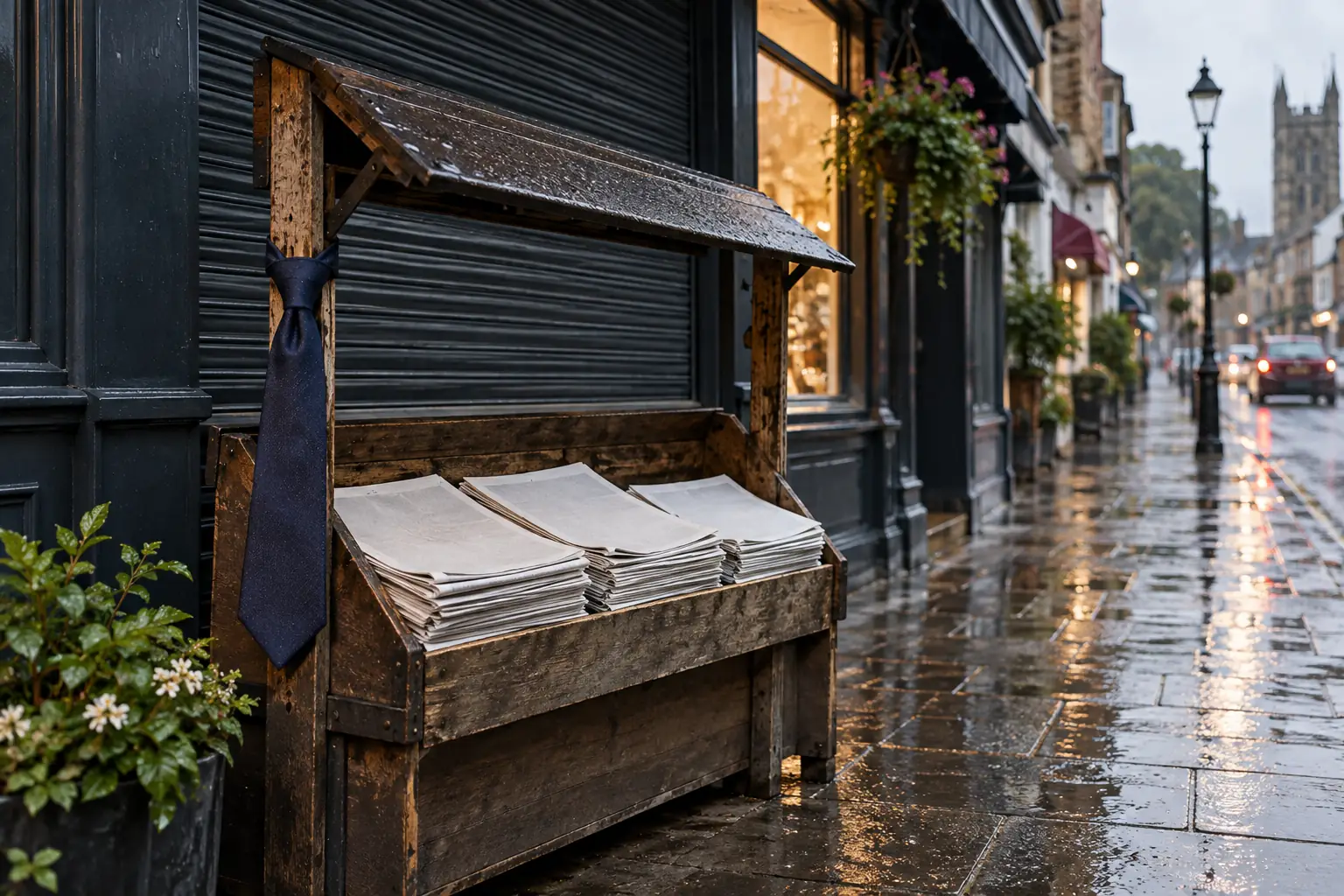
The Government has launched a £12 million Local News Fund to help journalism reach communities that have lost their local news, leaving one empty newsstand wondering whether its application should include a photograph of itself.
Announced on 7 July 2026, the fund allows local news organisations to seek grants of up to £125,000. The first year has £6 million available, with up to another £6 million planned for 2027/28. A separate part of the programme will support infrastructure, while £1 million in the second year is intended to tackle local news deserts.
This is a serious attempt to support an industry that has discovered the market considers civic information an optional extra, somewhere between a second teabag and a working high street. The Government says the money can help publishers invest in digital tools, multimedia and new ways to reach audiences. The empty newsstand has responded by downloading an app, although it still cannot find a wall.
The official announcement says as many as 4.4 million people live in areas without a dedicated local newspaper, website, television or radio outlet. That leaves communities with fewer ways to follow local decisions, scrutinise public bodies or discover that a roundabout has been redesigned at considerable expense.
Applicants face a competitive process and must show a track record in providing local news in England or Wales. This may disappoint several ambitious community groups whose entire track record currently consists of knowing where the council keeps the bins. The empty newsstand, meanwhile, has begun assembling evidence of long term financial sustainability by locating a coin beneath its till.
The fund also invites innovation, which is the official word for asking journalism to survive in a new format whenever the old format is taken away. Local outlets are expected to find new audiences and new revenue streams, presumably without frightening either audience or revenue stream during the introduction.
Here is the contradiction. Reliable local journalism is treated as essential to democracy, but its survival is organised through a grant competition that requires applicants to prove they are already good at surviving. It is rather like offering a life jacket to anyone who can demonstrate a proven ability to remain dry.
The empty newsstand has submitted its proposal for a digital transformation, a multimedia strategy and one small reporter who can explain why the bus has vanished. Its final budget line concerns public interest, subject to availability. The panel asks whether the newsstand can demonstrate an audience. It gestures towards the pavement, where three people are waiting for a bus that no longer exists, and calls this its first successful community partnership.
Source: GOV.UK.