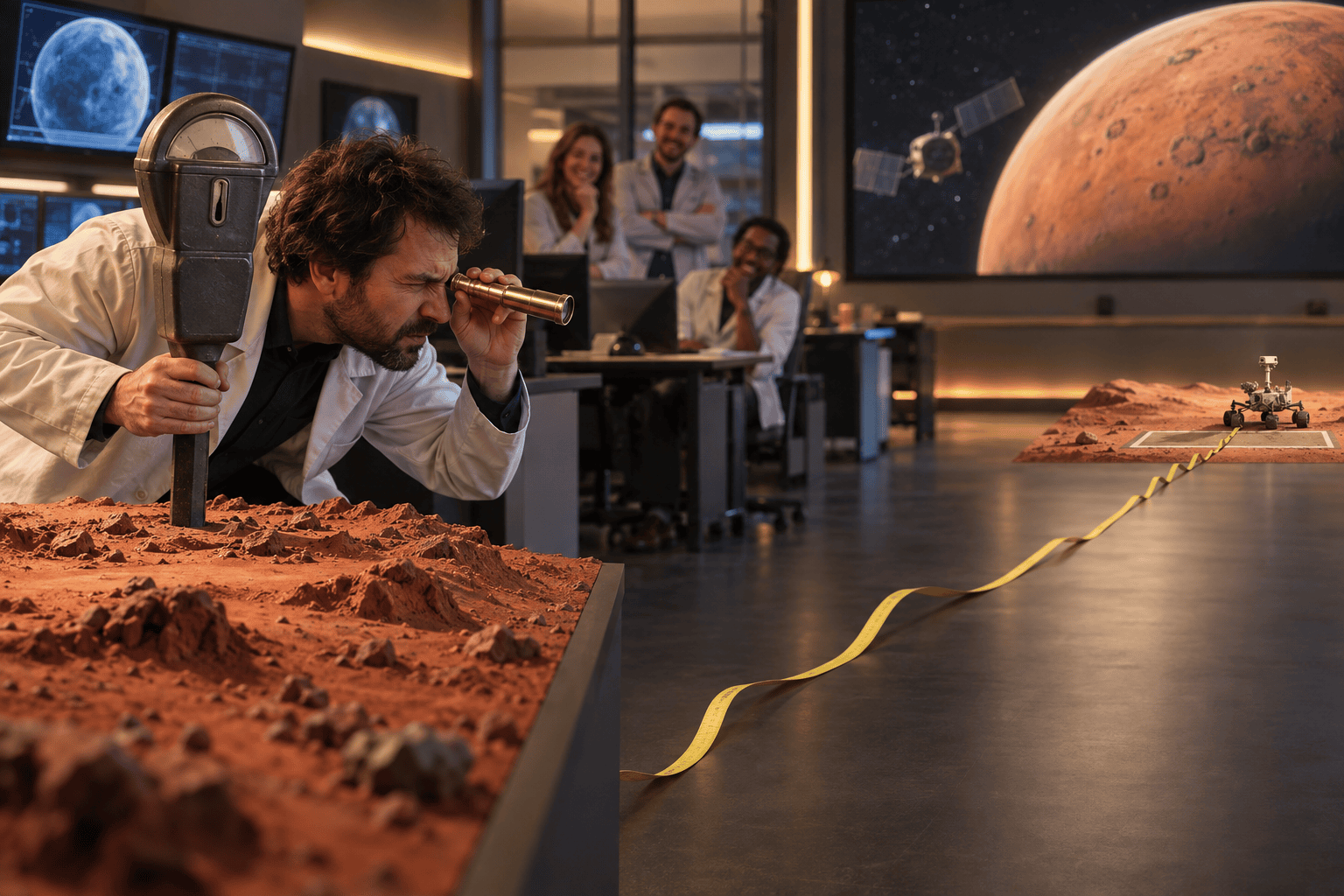
ESA’s Hera Mars flyby has moved humanity’s search for ancient Martian life towards its natural conclusion: an orbital survey to confirm the planet has somewhere to leave the rover.
Hera flew over Oxia Planum, a clay rich region chosen for the Rosalind Franklin rover’s planned 2030 arrival. The rover will hunt for evidence of ancient life. First, Europe must make sure its small robot does not spend the mission trapped in a pebble of historical importance.
A very quiet viewing
Oxia Planum may preserve chemical traces from a wetter Mars. This makes it scientifically important, which is much like a British town becoming historic the moment somebody proposes a bypass.
Professor Lionel Dust-Mirror of the Interplanetary Parking Standards Board said, “The clay could tell us whether Mars once had life. We will examine that once we know the rover can approach it without looking as though it has lost an argument with a kerb.”
Mission planners liked the site’s broad, flat appearance and total lack of competing bidders. One map marks likely ancient water deposits. Another asks whether the rover could investigate them from just outside the boundary, where it would be safely beyond responsibility.
No Martian residents attended the inspection, partly because there are none and partly because the notice arrived several billion years late. Even so, the exercise produced a reassuring quantity of maps, arrows and the feeling that a simple question had been escorted into a committee room.
ESA said the flyby was scientific reconnaissance, not property speculation. That will remain true until the rover finds a fossil, at which point somebody will call the area a heritage quarter and erect a board nobody can read without a spacesuit.
Hera then continued its journey, leaving Oxia Planum undisturbed for another five years. If Mars once had life, its descendants can take comfort from Europe’s first contact: a civil servant asking whether their ancient civilisation has considered visitor parking.
Read the real story: ESA’s Hera Mars flyby report.