Britain has answered a suspected Hantavirus case on Tristan da Cunha by dropping medical personnel, oxygen and equipment from the sky, proving that the national emergency plan is a parcel service with military qualifications and absolutely no interest in a normal delivery window.
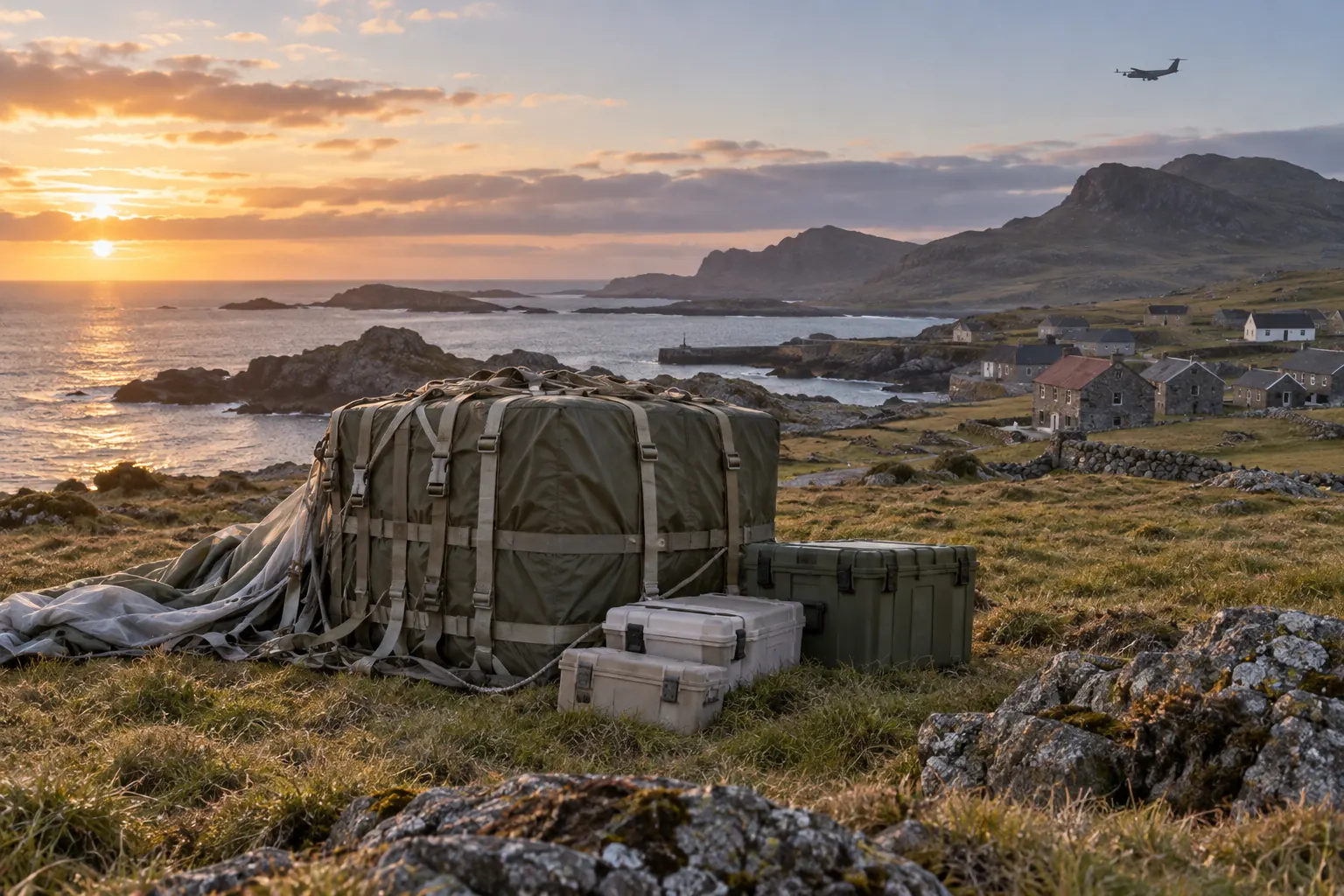
On 10 May 2026, the Ministry of Defence said an Army specialist team parachuted from an RAF A400M onto the remote South Atlantic territory. Tristan da Cunha has no airstrip and is normally reached by boat, so the usual route was apparently defeated by the ocean, the distance and the awkward fact that a patient cannot be asked to wait politely for favourable sailing conditions.
The operation involved six paratroopers and two military clinicians from 16 Air Assault Brigade. Oxygen and other medical supplies were dropped at the same time. Diagnostic supplies including PCR tests had already reached Ascension Island on 7 May, giving the logistics chain a supporting cast, a sequel and at least one box that had travelled farther than most holidaymakers.
There was nothing frivolous about the need. The Ministry said oxygen supplies on the island had reached a critical level. Tristan da Cunha has 221 inhabitants and a two person medical team, which means the local health service has been asked to cover an entire volcanic territory with the staffing model of a particularly optimistic village surgery.
The military team travelled thousands of kilometres from RAF Brize Norton through Ascension Island. An RAF Voyager refuelled the A400M in mid air, because the only thing more remote than Tristan da Cunha is apparently a petrol station prepared to meet a transport aircraft at altitude and ask whether it has loyalty points.
Officials presented the mission as proof of Britain’s speed, reach and commitment to its overseas territories. The operation certainly demonstrated speed and reach. It also demonstrated that when government logistics truly commits itself, even a cargo crate can receive a parachute, an escort aircraft and the sort of administrative attention usually reserved for a major infrastructure project.
The fictional cargo crate has now submitted its landing form, its customs declaration and a statement explaining why it arrived from above. It is waiting for the final approval from the department responsible for confirming that a box which has just fallen out of an aircraft is, after extensive review, definitely on the island.
Source: GOV.UK.