 Satirical illustration. Not a documentary photograph.
 The fusion AI spinout promises traceable engineering decisions, allowing Britain to identify who renamed the fatal spreadsheet before lunch.
Britain’s fusion AI spinout has discovered a new source of limitless energy: writing ‘strategic investment round’ on a press release. Unlike fusion, this process already works. It converts one laboratory, four investors and a conference lanyard into enough optimism to power Swindon until Thursday.
The UK Atomic Energy Authority announcement says it has spun out Singular Machines from Britain’s national fusion laboratory. The company has investment from four organisations and a fresh contract with Arup. Therefore, the nation may finally commercialise its most abundant natural resource: engineers asking which spreadsheet is current.
Fusion AI spinout enters the blame chamber
Singular Machines is developing coEngen, an agentic AI platform for complex engineering. It aims to preserve traceability, assurance and professional judgement. In normal office English, the machine remembers who changed the important number while everybody else was saying ‘fine by me’ on mute.
However, the platform keeps experts at the centre of decisions. This avoids the usual technology launch where a dashboard studies twelve years of professional training and recommends turning the engineer off and on again. It also prevents management from replacing a structural specialist with a dropdown menu labelled ‘probably fine’.
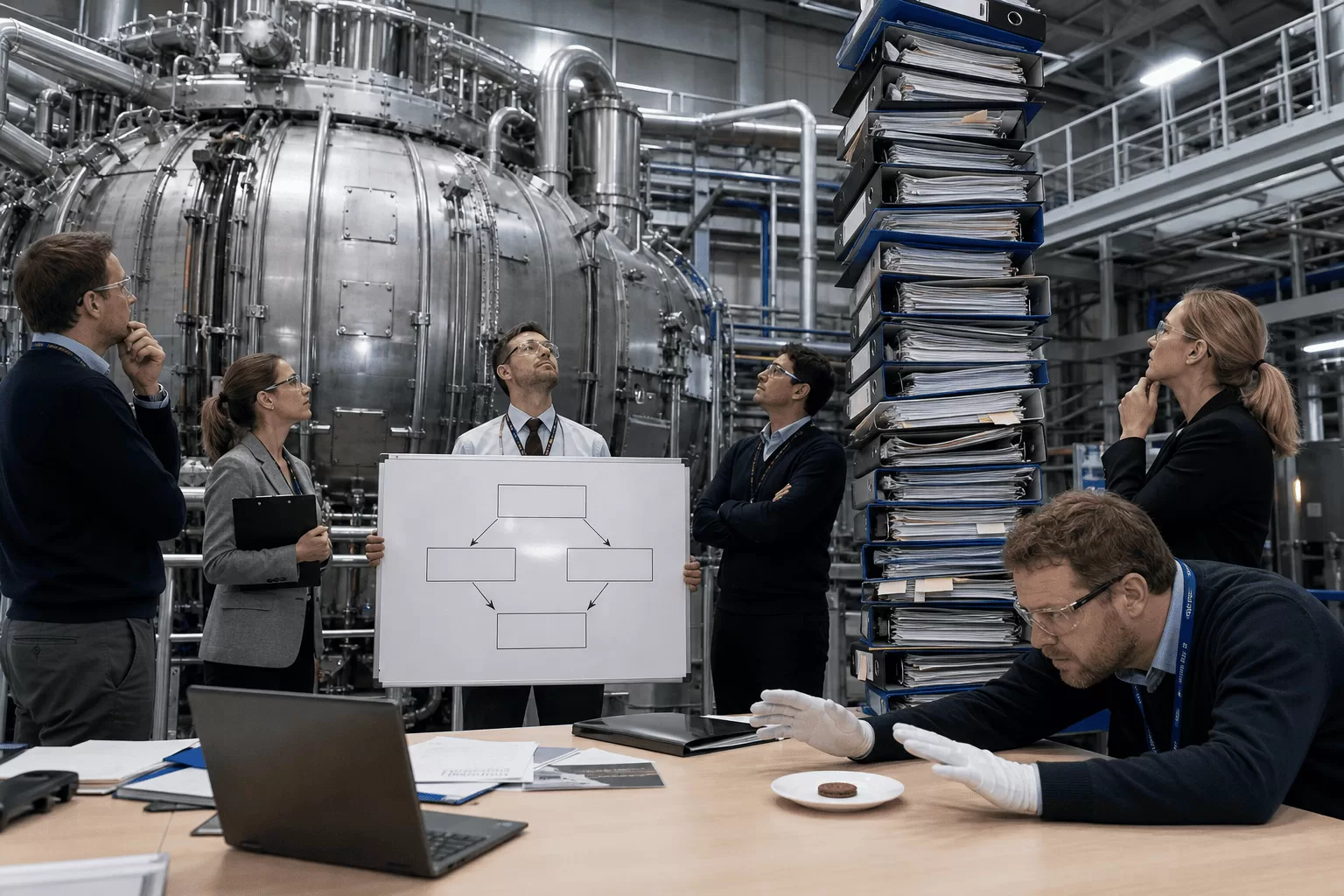
In The Lawn’s entirely fictional demonstration, coEngen joins six engineers in a windowless room. First, it traces one decision to a calculation. Next, it traces another to a Post-it note. Finally, it finds three design changes inside a meeting called QUICK CATCH-UP, an event previously believed to leave no survivors or minutes.
Fusion AI spinout protects professional judgement
The fictional system does not replace the engineer. Instead, it follows them with a digital clipboard and records every warning. When management chooses the cheaper option, coEngen opens a tiny umbrella and calculates the exact Tuesday on which everyone will describe that warning as ‘more of a general vibe’.
Meanwhile, Arup will help shape and test the real platform through engineering workflows. The firm has also invested and signed a contract to use it. Consequently, coEngen will enter the natural habitat of modern engineering: strict assurance, complex projects and nine competing documents called Single Source of Truth.
Traceability could transform the British meeting. At present, every decision begins with ‘as discussed’ and ends with nobody recalling a discussion. With coEngen present, ‘as discussed’ may become a legally discoverable cry for help. Moreover, ‘circling back’ could finally require a pilot’s licence.
Prosperity receives its ceremonial lanyard
UKAEA says the spinout supports its 2026–2030 strategy. That plan seeks commercial opportunities from fusion research and broader value from public investment. It also mentions skills, intellectual property, high-skilled jobs and industrial growth, completing the official prosperity set without once needing the phrase ‘levelling up’.
The entirely invented Department for Turning Research Into Rectangular Logos has welcomed the news. Its fictional officials have prepared a forty-page pathway from laboratory insight to reusable tote bag. Stage one is innovation. Stage two is a panel event. Stage three is discovering that the panel event needs an innovation workstream and six branded muffins.
Investors will recognise Britain’s deep-tech ritual. Scientists solve a difficult problem. Then a company appears with a capital letter hiding in the middle of its name. After that, thoughtful people stand beside machinery they cannot touch while a photographer asks them to look more disruptive.
The machine remembers what Britain cannot
Still, there is a serious idea beneath the corporate fog. Complex engineering needs clear evidence, accountable decisions and expert oversight. A tool that preserves the history of a decision may prove useful. Yet the announcement does not establish how well the platform performs or what its industrial results will be.
For now, Britain can celebrate software designed to preserve professional judgement. It may become the first machine capable of proving the engineer warned everyone in March. More importantly, it could reveal who renamed FINAL_v12_USE_THIS_ONE to FINAL_v12_USE_THIS_ONE_ACTUAL.
Then the country can begin the harder engineering challenge: finding the person who deleted column G.