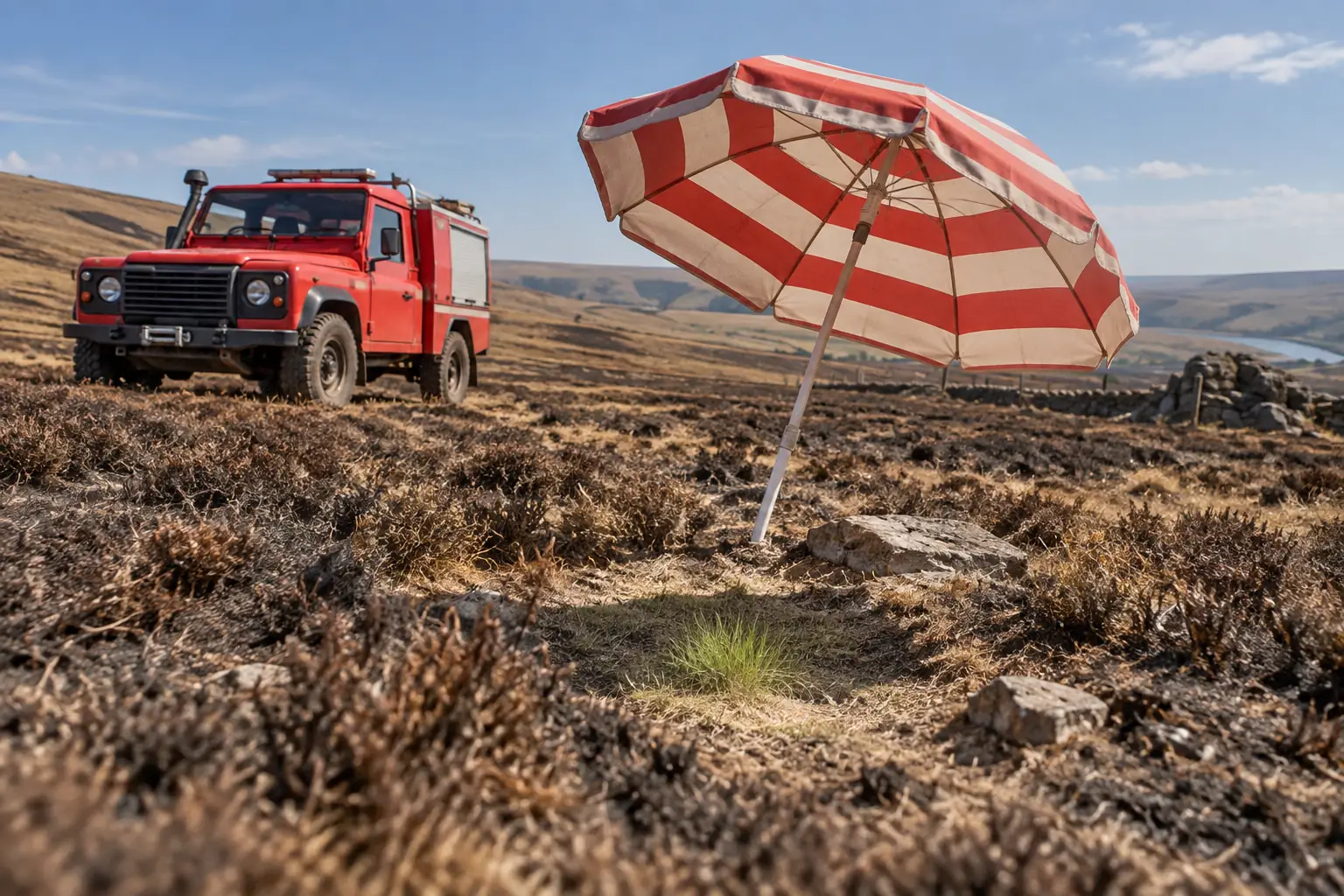
The government has announced specialist wildfire teams and almost £100 million of upgraded fire and rescue equipment, giving Britain a national response to a problem that has shown a touching disregard for departmental boundaries. The beach umbrella welcomes the investment, while asking whether one blade of grass might be placed on the priority list.
The announcement on 20 June said specialist firefighters would be positioned in Lancashire, Greater Manchester, Northumberland, London and South Wales, ready to deploy to incidents across England. They have trained in tactics including tactical burning and travelled to South Africa and Poland to learn from international colleagues.
This is the point at which a sensible country buys useful equipment and trains people to use it. It is not, strictly speaking, a comedy premise. Unfortunately, the announcement also supplied almost £100 million of state of the art kit, a growing national risk and the phrase “peak season”, allowing official language to wander into the territory of a summer brochure for the apocalypse.
The wider investment will upgrade National Resilience fire and rescue assets, including dedicated off road vehicles. The programme was established after the 9/11 terrorist attack to provide specialist resources for national scale emergencies. It was used more than 1,000 times in 2025, covering incidents from flooding to wildfires and collapsed structures.
Somewhere, a procurement document is now attempting to distinguish between an emergency vehicle and a vehicle that has merely been purchased during an emergency. The difference appears to be a column in a spreadsheet marked “strategic”, which is where ordinary wheels go to acquire national importance.
The official logic is reassuringly straightforward. Wildfires are a growing demand on the service, so firefighters need training, equipment and mobility to respond quickly. This is considerably more useful than asking a local crew to approach a national disaster with a hose, a map and the quiet confidence that someone has definitely submitted a form.
The beach umbrella has therefore accepted that resilience is not the same as optimism. It is the machinery, people and preparation required when optimism has been left outside in a heatwave. It has also requested a dedicated off road vehicle, although the request was rejected because it is already technically portable.
By the end of June, the specialist teams are intended to be ready for deployment. The grass has been informed that help is on the way. It is now standing by for the £97 million upgrade to the national sprinkler of public reassurance, provided nobody loses the form authorising the water.
Source: GOV.UK.