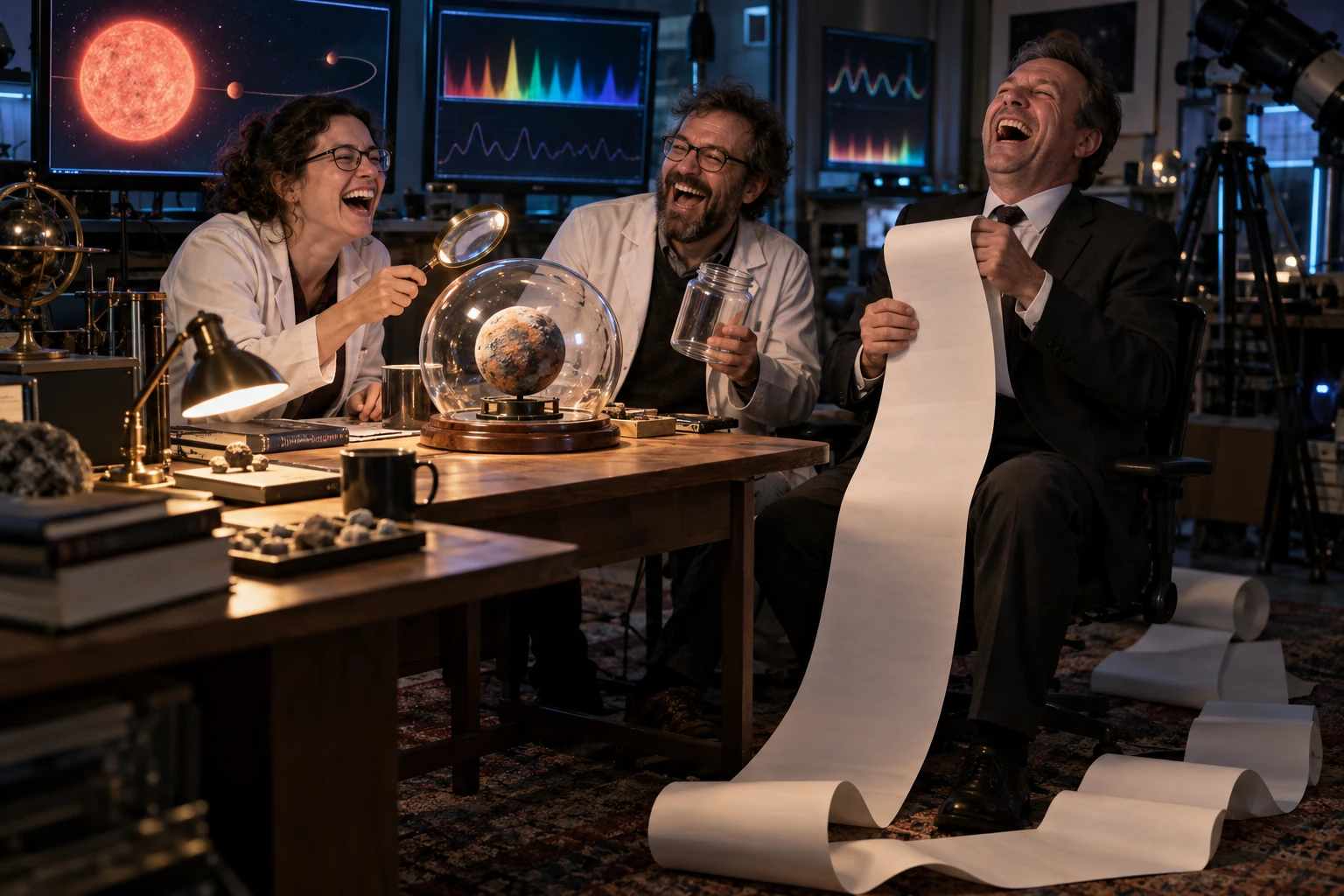
Planet e has declined to confirm whether it possesses an atmosphere, explaining that four observations by the James Webb Space Telescope are not enough evidence to complete the planetary disclosure form.
The Earth sized world sits in the habitable zone of its red dwarf star, where liquid water could theoretically exist if the planet has the right atmosphere. Estate agents have therefore described it as promising, subject to survey, heating and the discovery of an entire climate.
NASA says Webb’s initial observations make a thick original hydrogen and helium atmosphere unlikely. They do not establish whether planet e has a secondary atmosphere, no atmosphere at all, or a surface environment that would make an excellent argument for staying home.
Dr Celeste, Chair of Extraterrestrial Conveyancing, has prepared a statement saying the planet is not refusing to cooperate. It merely asks humanity to stop treating four glimpses through space as a completed planning application.
The difficulty is that the red dwarf is active and prone to flares, which can complicate the signals reaching Webb. A flicker from the star can resemble evidence from the planet, allowing cosmic weather to enter the investigation as an unreliable witness that keeps changing its story.
Webb’s infrared instruments examine starlight as planet e passes in front of its star. If the light has travelled through an atmosphere, its spectrum may reveal which gases are present. For now, the data permit several possibilities, including bare rock and an atmosphere that has sensibly chosen not to make a public statement.
No evidence currently establishes habitability or life. This restraint has disappointed the internet, which would prefer to identify an alien civilisation before the planet has finished filling in its postcode.
Planet e has now disclosed one thing with confidence. Its solicitor says everything else remains under review until the universe provides better paperwork, preferably stamped by an agency that can prove it has an atmosphere.
Real story: NASA.