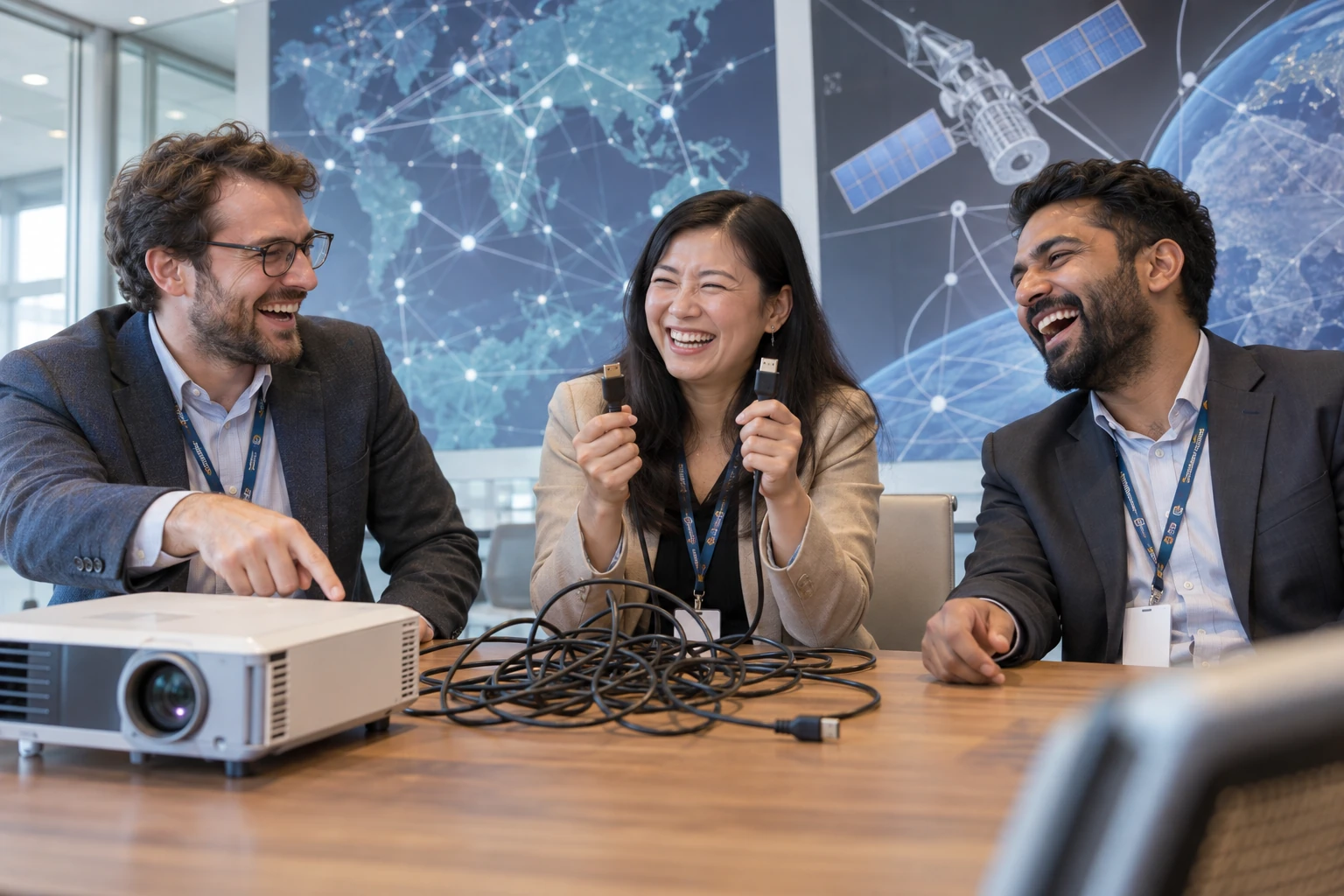
Britain and India have committed a combined initial £24 million over four years to a Connectivity and Innovation Centre working on artificial intelligence for telecoms, non terrestrial networks and telecoms cybersecurity. Its first practical test is identifying which cable makes the launch presentation appear.
The centre is meant to bring together complementary strengths in British and Indian innovation, with BT, Ericsson and Nokia among the industry partners planning to contribute to its research. This is a serious attempt to make communications more secure and reliable, although every strategic corridor begins with someone asking whether the screen is plugged in.
The Department for Science, Innovation and Technology has set out three grand priorities. Transform telecoms with AI. Develop networks that operate beyond the ground. Improve telecoms cybersecurity. The Department of International Adapters has added a fourth, stopping one attendee from whispering “try turning it off and on again” during the ministerial photograph.
In the joke version of the launch, Professor Anil Switchboard, Fellow of Productive Signals, offered the following entirely invented wisdom: “We will connect the future once the projector accepts that input two is not a personal insult.” It is a useful reminder that even the most advanced network still depends on a small box that flashes angrily when ignored.
The centre forms part of the UK India Technology Security Initiative and is presented as a flagship example of the wider Research and Innovation Corridor. The Office of Mutual Bandwidth has banned “game changer” from its event because nobody can establish whether the game is being played over Wi Fi, satellite or the cable labelled “old one”.
That is the contradiction worth keeping. Modern connectivity promises to remove friction from daily life, while its launch language arrives in a fog of shared ambition, strategic partnership and priority technology. All three phrases sound expensive. None can persuade a laptop to recognise the conference room screen.
There is nothing foolish about checking the equipment. Reliable systems are built from dull details, repeated testing and people who know which warning lights matter. The joke begins when an institution devoted to the future of communication briefly becomes a hostage situation involving a projector, three adapters and a person saying they definitely had the cable a moment ago.
Britain and India may yet produce faster and safer networks for millions of people. For now, the centre has achieved a remarkable international breakthrough: two countries have united around a single shared objective, finding the person who took the HDMI cable home and is currently presenting from it.
Real story: Department for Science, Innovation and Technology.