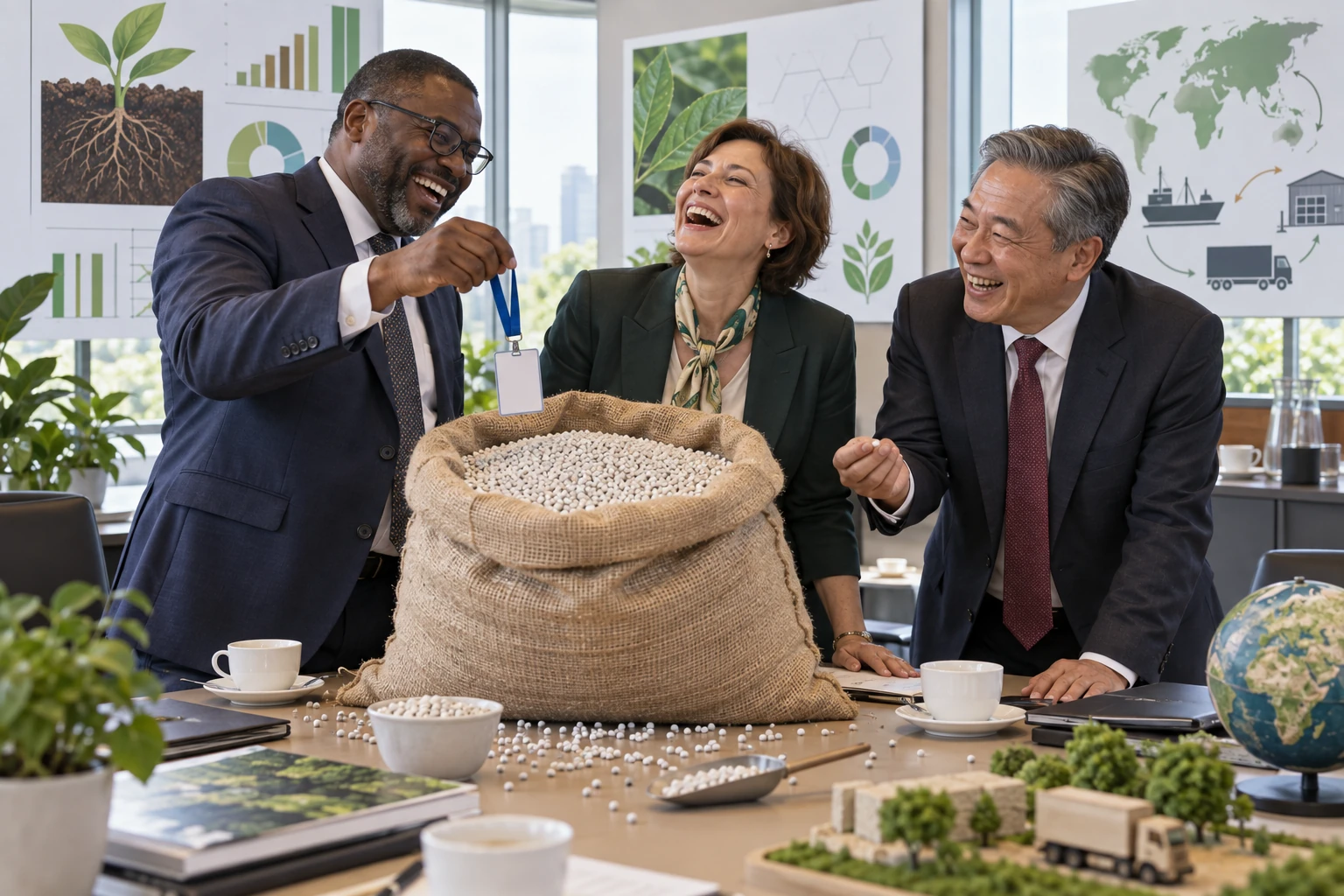
The UK and Brazil have promoted a bag of fertiliser pellets to global leadership, because the future of food resilience apparently begins when a granular substance receives a bilateral framework and learns to say “stakeholder”.
The two countries have signed a partnership aimed at reducing the environmental impact of fertilisers and strengthening food production. Its priorities include biodiversity, lower greenhouse gas emissions and more resilient supply chains. This is serious work, although the announcement does ask a sack of pellets to stand in a conference hall while officials explain its economic opportunities.
The partnership arrives ahead of COP30, where international cooperation on sustainable fertiliser production and use is due to receive further attention. It covers research, innovation, supply chain resilience and the sharing of best practice. A substance usually scattered over a field has therefore been invited into the international system and is expected to contribute constructively.
The newly created International Office of Nutrient Alignment has already produced a diagram showing one grain of fertiliser becoming a policy lever, a climate solution and, by page four, a modest regional ambassador.
Poppy Granule, Deputy Envoy for Things That Improve Soil but Cannot Chair a Panel, delivered the obvious briefing. “We need cooperation. So we brought the countries together, gave the pellets coffee and asked them to build resilience by lunchtime.”
Fertilisers are crucial to food production, while their manufacture and use can create serious environmental consequences when poorly managed. The partnership therefore has a genuine problem to solve. Unfortunately, the announcement makes a bag from the garden centre sound as though it will attend COP30 with a lanyard, a position on biodiversity and a carefully rehearsed view on governance.
There is a sensible case for countries sharing research and improving how fertilisers are produced and used. The test is whether that cooperation reaches farms before the jargon reaches its second annex. A supply chain can be resilient, after all, while its paperwork remains dangerously overfed.
At the closing session, a pellet declined to comment. It said it was already under enough pressure, then requested a private meeting with the minister responsible for bulk communications.