The South Sudan peace deal has spent just over seven years demonstrating that a document can contain every useful word except the bit where people do what it says. The agreement promised peace and a transitional government of national unity. The transition appears to have stopped for refreshments, then appointed a committee to discuss the biscuits.
On 18 December 2025, Norway, the UK and the US issued a joint statement about the deteriorating situation. It said the 2018 Revitalised Agreement had suffered violations of its power sharing principles and made no meaningful progress towards implementation. This is diplomatic language for discovering that the fire escape has become a suggestion, then asking whether the suggestion has completed its paperwork.
The statement also said public servants were going unpaid while international donors spent significantly more on basic services than the government itself. Those facts deserve no joke at the expense of ordinary people. They do expose a leadership class that treats responsibility like a ceremonial hat, useful for photographs and mysteriously unavailable when the bill arrives.
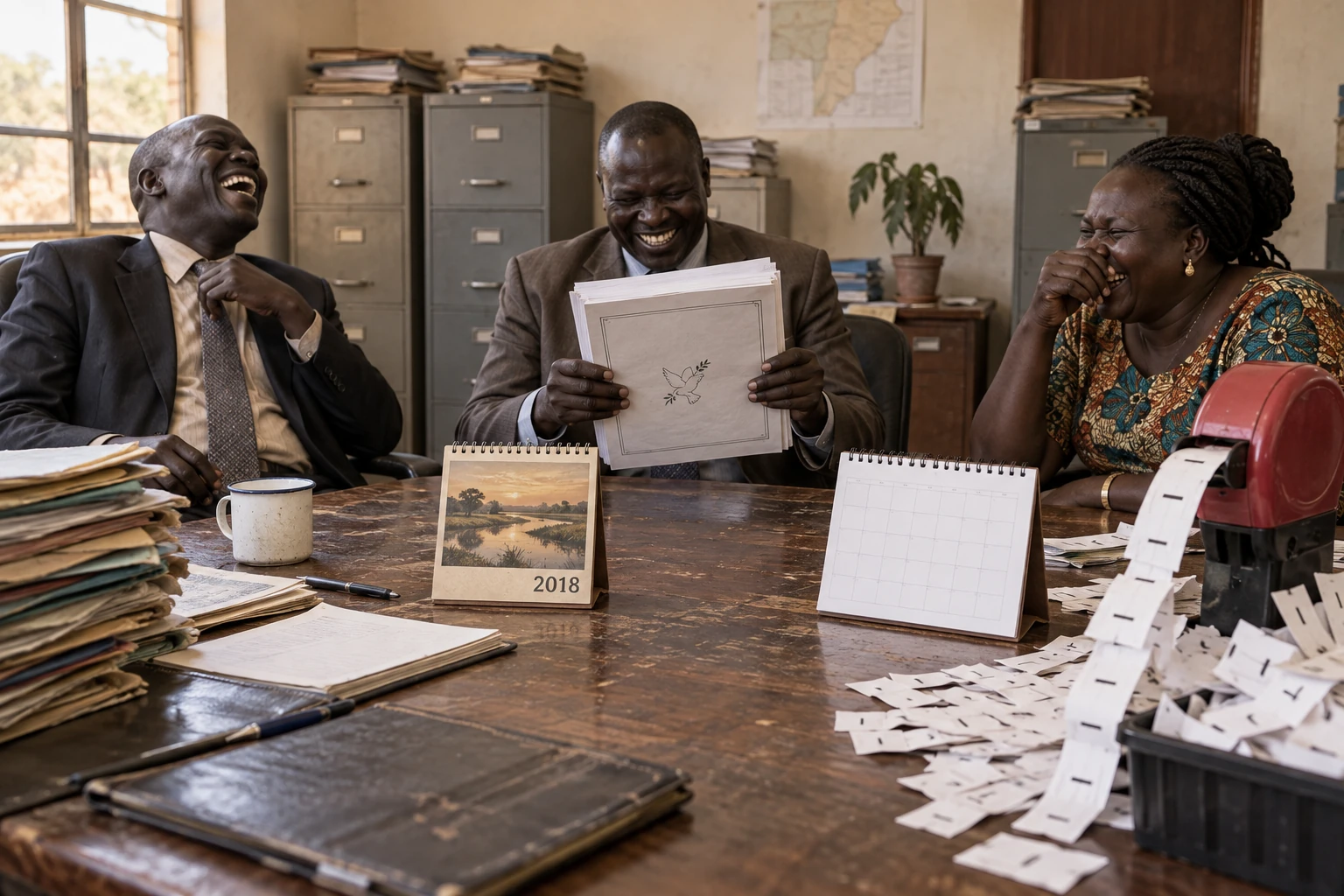
At the Department of Unfinished Transitions, protocol chief Basil Calendar opened the agreement. “It clearly says revitalised,” he said. “We interpreted that as a request to refresh the cover page and schedule a workshop about resilience.” The department then filed the workshop under urgent action and scheduled urgent action for a later review.
The agreement created obligations. It expected leaders to share power, restore trust and move the country towards stability. Instead, the statement called for an end to interference with humanitarian providers and for aid workers and international organisations to be allowed to operate. Nothing says confidence in national administration like making the people with food, medicine and logistics fill in an extra form before they are permitted to help people survive.
It also called for the conflict to stop, public sector employees to be paid and essential services to be funded. These are not ambitious gimmicks. They are the floor. Yet certain governments can look at a floor and commission a strategy for locating it, followed by a panel on why everyone keeps falling through it.
Policy observer Mavis Ledger put the problem plainly. “A transitional government should transition,” she said. “Otherwise it is just a waiting room with flags, expensive chairs and a very determined queue.” The chairs, at least, appear to have completed their term.
There is a serious point beneath the joke. Agreements only matter when leaders honour them. Salaries, safety and basic services cannot live forever in the appendix of a communiqué. The people who need them already know how long a promise lasts when the people who made it own the diary.
The peace deal has done what paper can do. It has remained on the table, looking increasingly like the only participant keeping its appointment. The leadership now has the more difficult task of reading it. After seven years, the agreement may need to be promoted from document to eyewitness.