
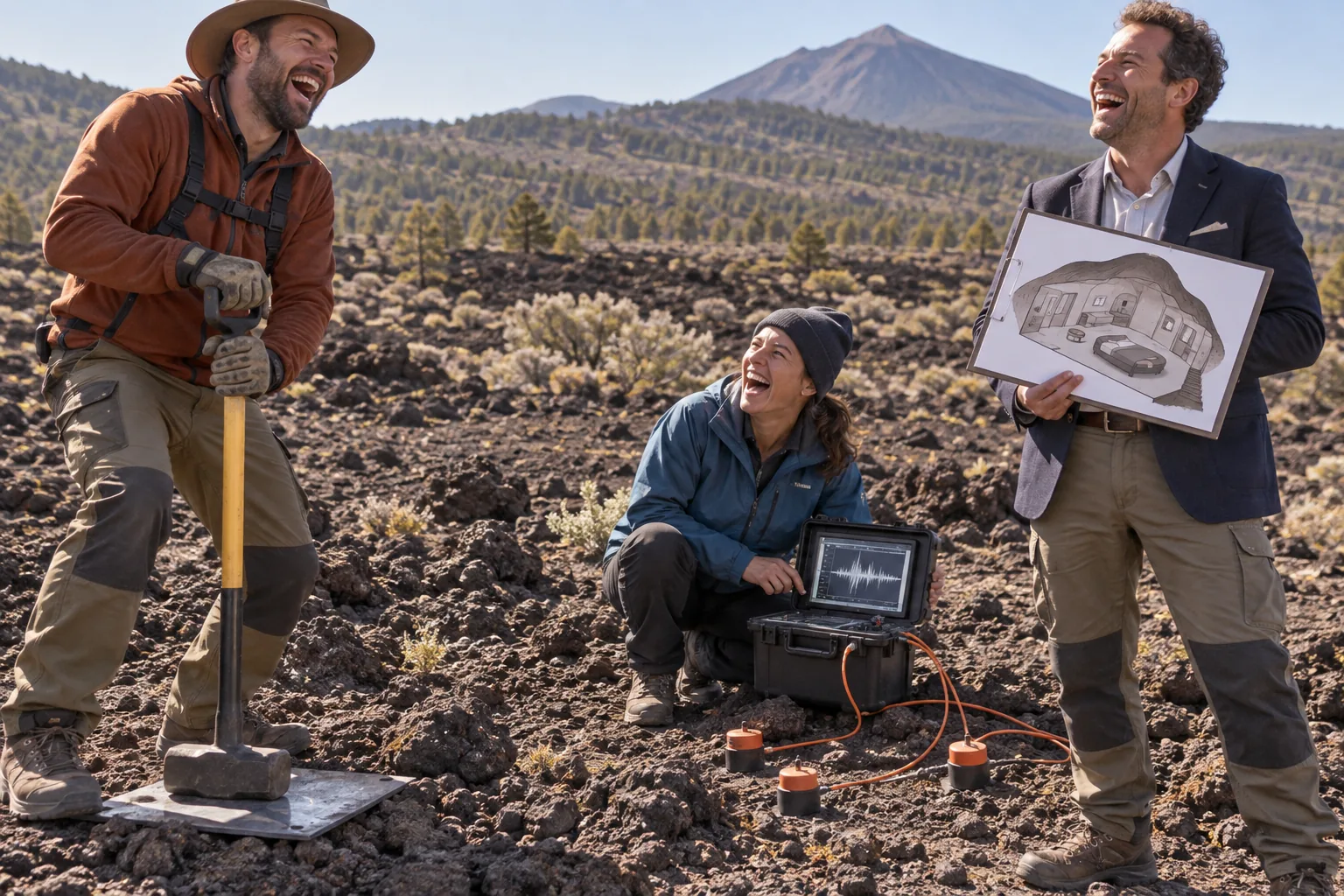
NASA’s search for future Moon shelter has reached the stage familiar to anyone who has inspected a suspicious wall, a loose paving slab or a neighbour’s extension: hit the ground and listen for an expensive void.
A research paper first published in August describes a seismic method tested near Flagstaff, Arizona, and Tulelake, California. Researchers struck a metal plate with a 4.5 kg sledgehammer while instruments recorded how the vibrations scattered through the ground. The tests took place above known terrestrial lava tubes.
The method is less “finding a secret Moon home” than checking whether the floor plan contains a geological surprise. Seismic energy scatters around underground cavities, creating patterns that can indicate a lava tube’s location and approximate dimensions. The same approach might eventually help missions investigate caves on the Moon or Mars, where thick rock could offer protection from radiation, meteorites and vicious temperature changes.
Professor Thudley, Surveyor of Percussive Property, has accordingly revised the lunar viewing checklist. Natural light is now less important than knowing whether the ceiling produces a reassuring thud, a worrying thud or the sound of an entire kitchen disappearing into the geology.
The Office of Extraterrestrial Lettings has moved quickly. Its agents are presenting caves as characterful lower ground opportunities, with radiation shielding promoted as a lifestyle feature and the absence of atmosphere placed under minor considerations. The brochure promises authentic volcanic interiors, excellent privacy and neighbours who are unlikely to complain about drilling.
There is still a considerable distance between detecting a cavity on Earth and establishing a safe habitat elsewhere. A lunar lava tube could be structurally uncertain, difficult to enter and located hundreds of thousands of miles from anyone qualified to inspect the electrics. The hammer has detected a useful signal, but it has not installed plumbing, checked the roof or persuaded the Moon to accept an offer.
That has not stopped the first lunar open viewing. Visitors will be asked to bring sturdy boots, a radiation plan and proof that they can laugh politely when the agent describes no atmosphere as an unusually peaceful neighbourhood. The successful bidder will receive the keys, the cave survey and the traditional lunar guarantee that the property is completely sound, apart from everything holding up the ceiling.
Real story: Research paper, 22 August 2025, with later corroboration from NASA, 26 September 2025.