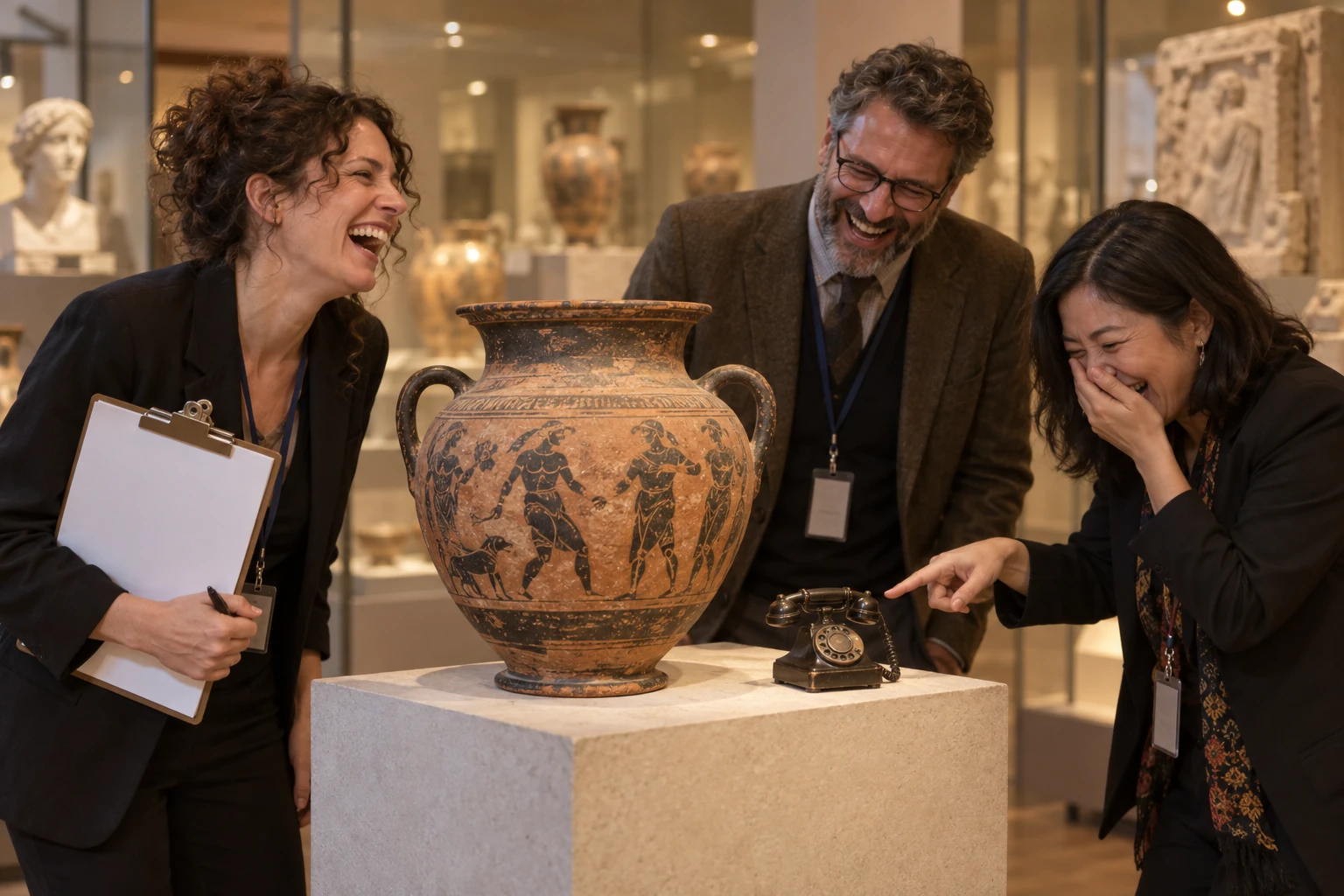
UNESCO and the International Council of Museums have strengthened their partnership, giving museums a new framework for sharing knowledge, protecting cultural property and building capacity. The ancient pot community has welcomed the news, although several members fear that knowledge exchange means another meeting about labels, followed by a survey asking whether the meeting improved their feelings about labels.
The agreement was formalised on 21 May 2025 at UNESCO headquarters in Paris. It brings the two organisations closer together on museum management, preservation and the social and educational role of museums. It also supports work against the illicit trafficking of cultural heritage, which is a serious international problem and not, as one gift shop briefly proposed, an exciting new loyalty scheme with points for returning stolen statues.
Rena Displaycase, Curator of Very Low Lighting, said the partnership showed what could happen when institutions combined expertise. “We can now coordinate our standards, share our methods and agree which cupboard contains the emergency biscuits,” she said. “This is how civilisation advances.” She then stared at a QR code until it apologised, making her the first museum professional to win a negotiation against a square.
The agreement also mentions new technologies, awareness raising and knowledge exchange. The Department of Object Feelings has interpreted this as permission to give every artefact a professional development plan. The Roman spoon has been assigned a mentor from Athens. A chipped bowl has been placed on a leadership course, despite having spent centuries demonstrating that it already knows how to hold things together. The bowl has declined to discuss its growth areas.
There is a practical purpose behind the paperwork. Museums need shared expertise when collections are threatened, when cultural property is illegally traded and when institutions are preserving objects that have survived wars, empires and visitors leaning over the barrier to take a better photograph. Cooperation can make that work stronger. It can also ensure that twelve institutions produce twelve compatible strategies for telling people not to touch the exhibit.
International cooperation may help museums explain their wider value. They educate, preserve memory and give communities access to history. They also provide a quiet room in which a child can ask whether the dinosaur is still alive somewhere, while a guard prepares the approved answer, a small stool and a consultation paper on prehistoric stakeholder engagement.
By Friday, the ancient pot had received its first official message from abroad. It read: “Dear colleague, please stop calling us content.” The pot replied with a firmly worded crack, proving that after thousands of years it remains the only participant in the partnership willing to put its response in writing. The institutions are still drafting a framework for acknowledging this feedback.
Source: UNESCO.