
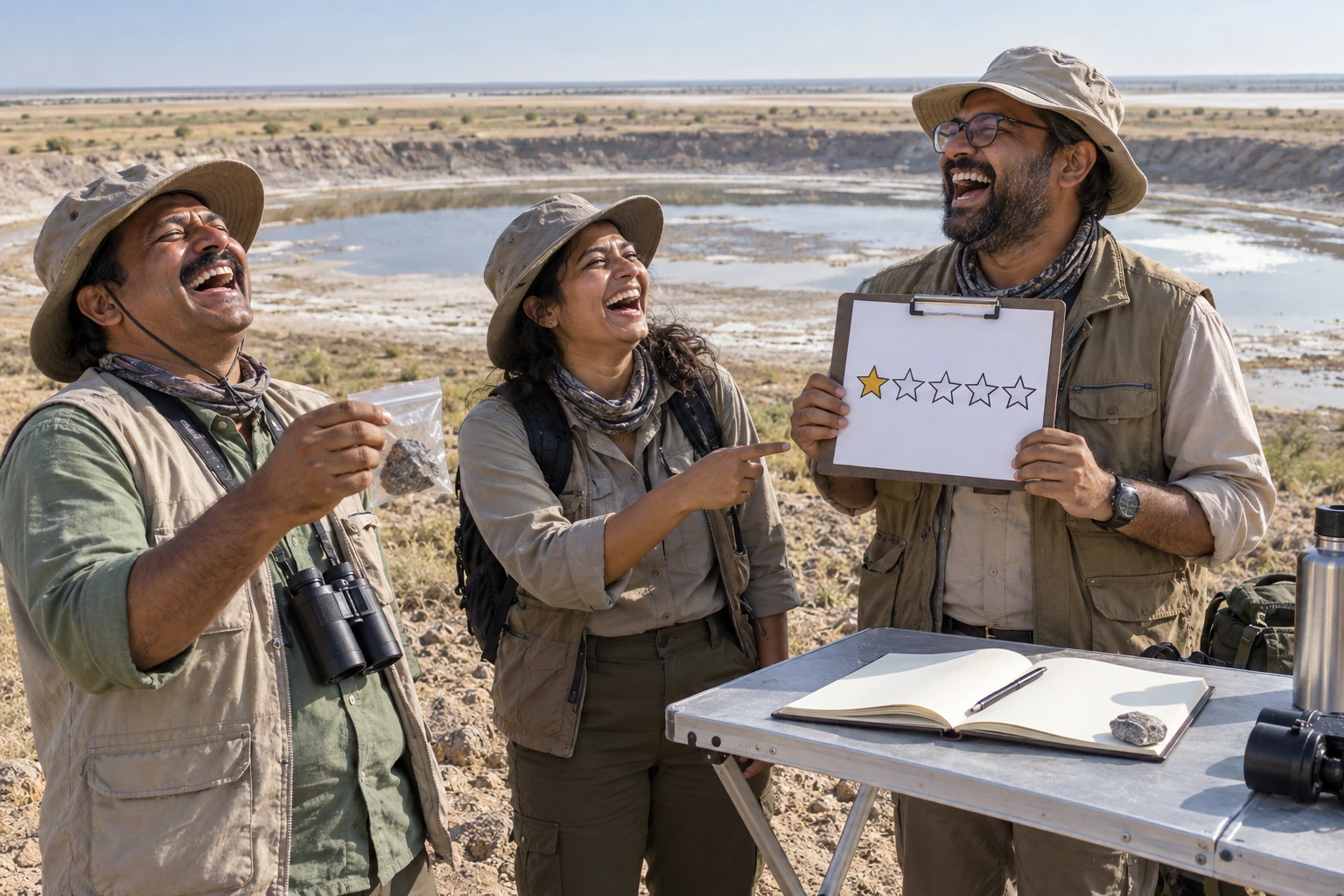
Scientists have found that India’s Luna crater was probably made by a meteorite, allowing space to deliver feedback in its least subtle format available: a 1.8 kilometre hole.
The crater sits in the Banni Plains near the Great Rann of Kutch, where the landscape already contains salt, water and enough exposed earth to suggest that nature has been experimenting without a planning committee. Luna often fills with water, so researchers waited for a dry period before asking the ground why it had such an aggressively circular expression.
Samples contained rare minerals formed under extreme heat and pressure. They also held unusually high levels of iridium, the geological equivalent of finding a hotel towel in somebody else’s suitcase and deciding the guest has made a serious statement. The evidence does not merely suggest that something happened. It suggests that something arrived with momentum and a complete absence of customer service training.
“The evidence is extremely persuasive,” said Dr Comet Chutney, Professor of Sudden Geography. “Normal ponds rarely arrive from above at several kilometres per second, unless the definition of pond has been revised by a committee with a meteorological budget.”
Researchers estimate that the impact happened about 6,900 years ago. This gives the meteorite an impressive record of avoiding follow up questions. It entered the neighbourhood, altered the landscape, left its chemical details all over the place and then allowed future generations to reconstruct the complaint from sediment.
Fewer than 200 impact structures are confirmed worldwide. Many have vanished beneath oceans, erosion or the general administrative preference for evidence that does not interrupt a landscape photograph. Luna remained in place for millennia, waiting for satellite imagery and a scientist carrying sample bags. Even geology eventually gets an inspection when the hole is large enough.
The crater is near the remains of an ancient Harappan settlement, although researchers cannot say whether people were present when the impact happened. If they were, the local planning minutes for that evening were probably brief, unanimous and devoted to finding somewhere with a roof.
The meteorite arrived without a booking, damaged the property, deposited iridium and disappeared without leaving a forwarding address. Its crater has now received a more thorough review than most hotels, and unlike the meteorite, the hotel would be expected to explain why the room contains a kilometre of missing floor.
Real story: NASA Earth Observatory.