
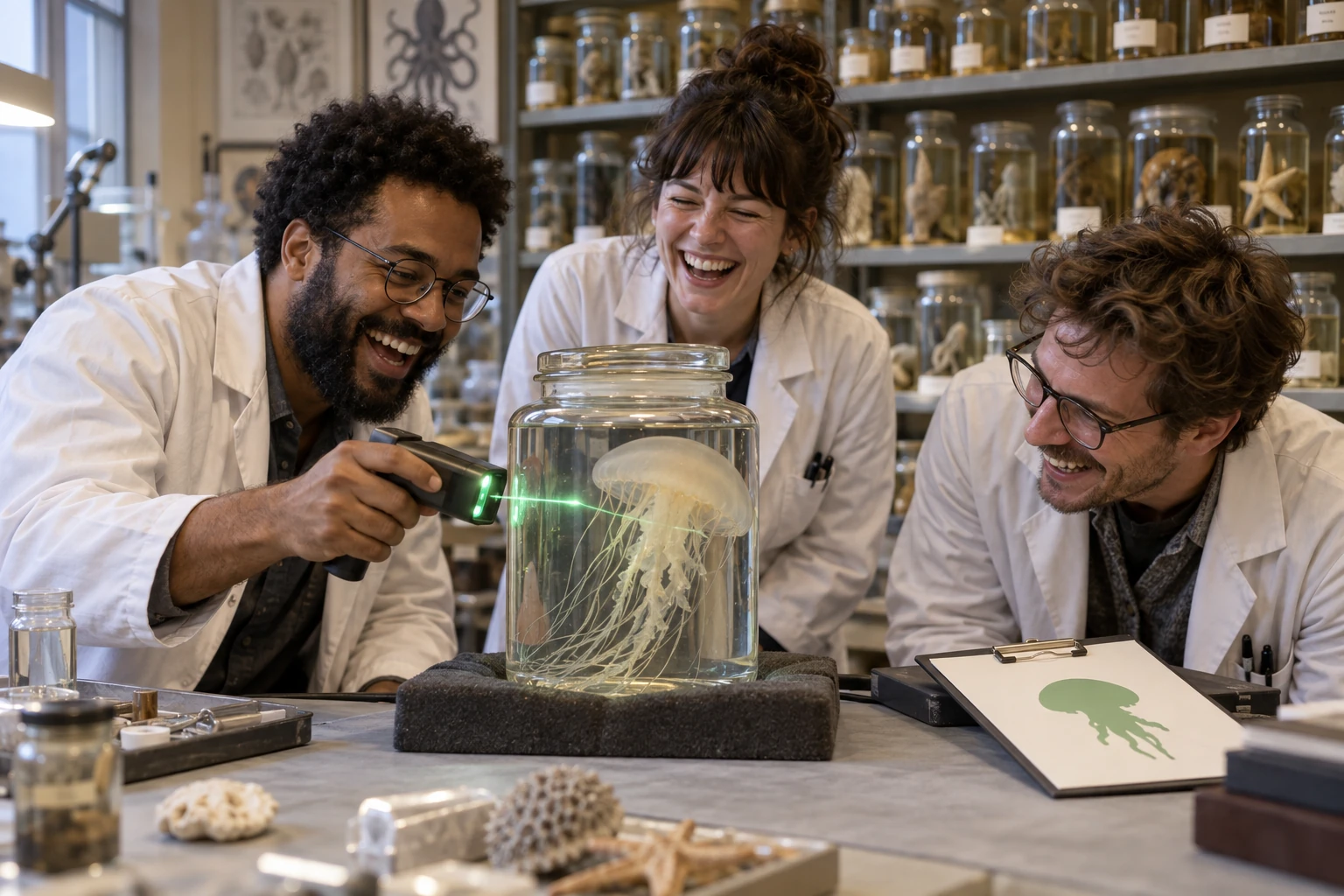
Researchers can now inspect historic museum jars without opening them, which means 200 year old preservation fluid may remain undisturbed, unjudged and safely beyond the reach of anyone saying, “Right, what have we got in here?”
The technique uses portable laser spectroscopy to identify fluid through the glass. Researchers tested 46 specimens at the Natural History Museum, including mammals, reptiles, fish, jellyfish and shrimps collected by Darwin and other naturalists. About 80% of the fluids were correctly identified, with partial identification in another 15%.
This is excellent conservation news. Opening an old jar can risk evaporation, contamination and damage to the specimen. It can also produce the sort of awkward silence normally reserved for discovering that the mysterious green liquid is not a museum smoothie, but something with a storage history longer than several governments.
The method shines a laser into the container and studies the light that comes back. The returned wavelength reveals which chemicals are present, allowing scientists to examine the contents without disturbing the glass, the fluid or the specimen that has spent two centuries being impressively motionless.
“We can now learn what is in a jar without lifting the lid,” said Professor Mabel Fizzwinkle, Keeper of Polite Lasers. “This is a major advance for science and a useful reminder that not every sealed container is improved by an enthusiastic adult with a screwdriver.”
Museums worldwide hold more than 100 million fluid preserved specimens. Knowing which fluids are present helps curators monitor collections and intervene before problems develop. The Department of Ancient Goop has therefore begun an inventory. Its first entry reads: “Greenish. Historical. Possibly judging us.”
The process can also identify the glass or plastic used for storage, offering clues about changing museum practice. One jar has received a clean bill of health. Another contained glycerol. A third spent 200 years labelled “miscellaneous” and is now requesting a category with fewer emotional consequences.
So the jars may finally enjoy the privacy they were promised, shortly before being collected, preserved, catalogued and placed under a bright light for visitors to inspect. Humanity has invented a laser specifically to avoid opening a jar, then put the jar on display to prove how respectful it is.
Source: UK Research and Innovation.