Britain’s third cycling and walking strategy will arrive after the Spending Review, because ministers have spotted a flaw in asking people to cycle. Most roads already contain cars, vans, holes and men who regard a high vis jacket as a personal accusation.
They promise 30 million extra active journeys. Officials will count anyone who leaves a late bus, crosses a road twice to find the pavement, or gets off a bicycle to negotiate with a delivery driver who has parked in the future.
Official pictures show happy families gliding through parks. Trees smile from places that no road widening scheme has yet eaten. On actual streets, cyclists get one blue sign, one broken kerb and a sudden order to share a lane with a skip.
A route is where the blue paint gives up
Myrtle Kerb-Slideshow of the National Pedal Possibility Unit said ministers understood continuity. “A cycle lane should continue until a van arrives. In Britain, that gives it about eleven seconds.”
Previous plans promised 300 miles of routes. Those miles now live mainly in government PDFs, where traffic flows, every council returns a form and no one drives a Range Rover to buy one loaf of bread. One wider pavement lets two adults pass, provided one agrees to become a postbox.
Ministers say active travel will cut congestion, improve health and save money. Their pilot junction tells cyclists to dismount, press three buttons and wait under a camera while an SUV turns left. Officials call that an active journey. The cyclist calls it estate planning.
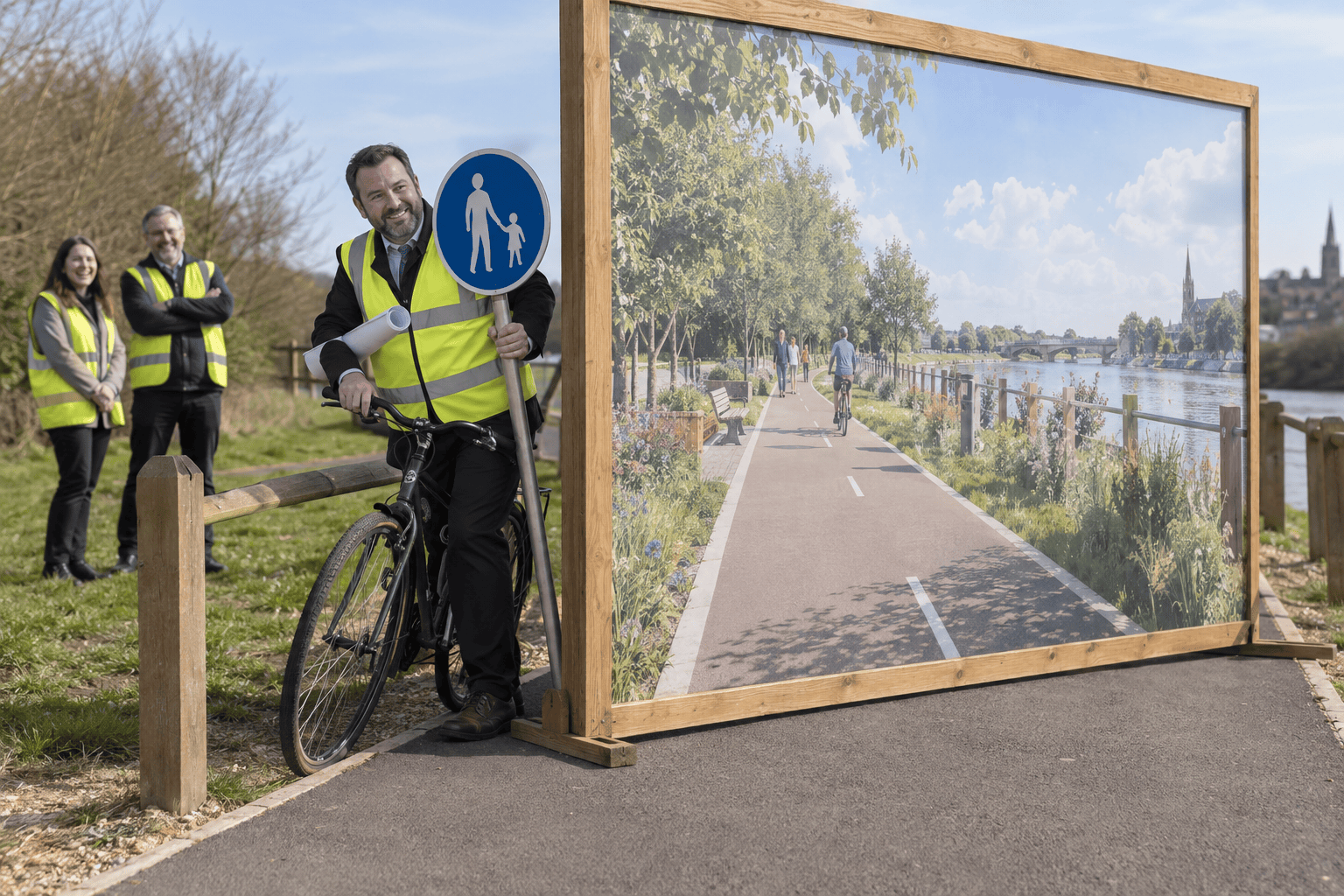
Officials took a ceremonial ride at the launch. It ended after 40 metres at an artist’s impression with no exit. They praised it as Britain’s safest cycle route, because reality had not yet received planning permission.
Read the real story: the cycling and walking investment statement.