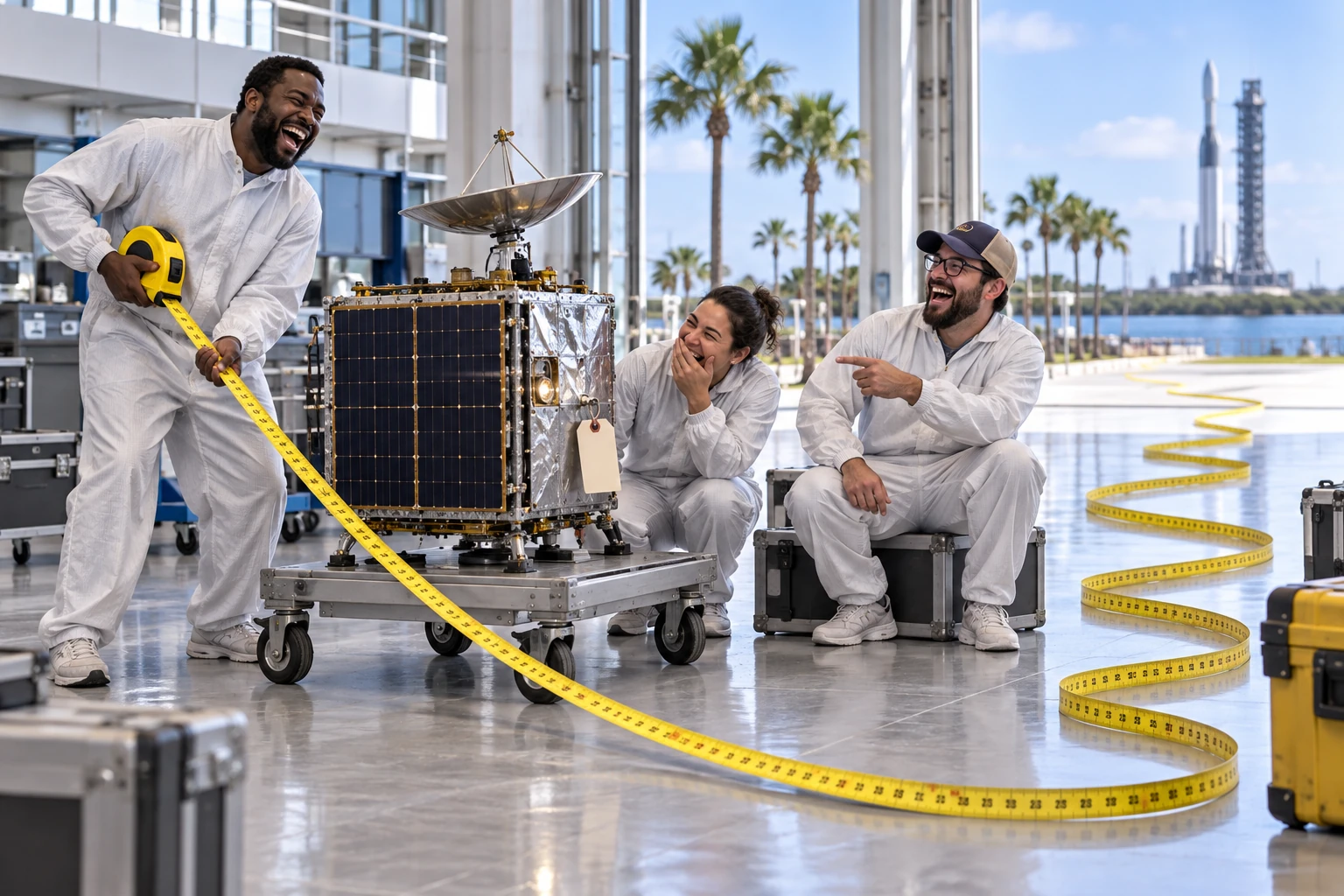
NASA’s Carruthers Geocorona Observatory has arrived in Florida for a mission involving Earth’s outer atmosphere, space weather and a journey so long that even the luggage tag has requested diplomatic status.
The small satellite is being prepared to operate at Lagrange Point 1, an orbit between Earth and the Sun roughly one million miles away. Before it leaves, the exosphere has been asked to remain available for ultraviolet photography and reminded that “please hold still” is not a recognised scientific instrument.
Carruthers will use ultraviolet cameras to study the exosphere and monitor how space weather affects it. This is serious work involving a region of hydrogen extending halfway to the Moon and possibly beyond. It is also the first space mission to make a missing charger sound like a logistical investigation.
At the Centre for Distant Looking, orbit planner Daphne Apogee said the team had prepared carefully. “We have packed the cameras, loaded the propellant and labelled the snacks according to orbital destination,” she said. “The extension lead remains optimistic, which is more than can be said for the launch timetable.”
The observatory arrived after workers transported it from Colorado to Florida, where it will continue launch preparations before joining the IMAP mission and another spacecraft on a Falcon 9 rocket. The equipment will eventually be sent a million miles from Earth, while most household parcels still consider the next county an ambitious delivery zone.
Chief Space Stationer Rupert Vacuum said the team would observe rather than guess. “That is the scientific method,” he said. “We have also instructed the clipboard not to become emotionally attached to the observatory. It will be travelling further than any of us.”
The Sun has been invited to provide space weather and has declined to confirm whether it considers this a collaboration. Meanwhile, Carruthers is being prepared to examine the edge of Earth’s atmosphere, proving that even the planet’s boundary has better forward planning than a railway replacement bus.
Real story: NASA Science.