
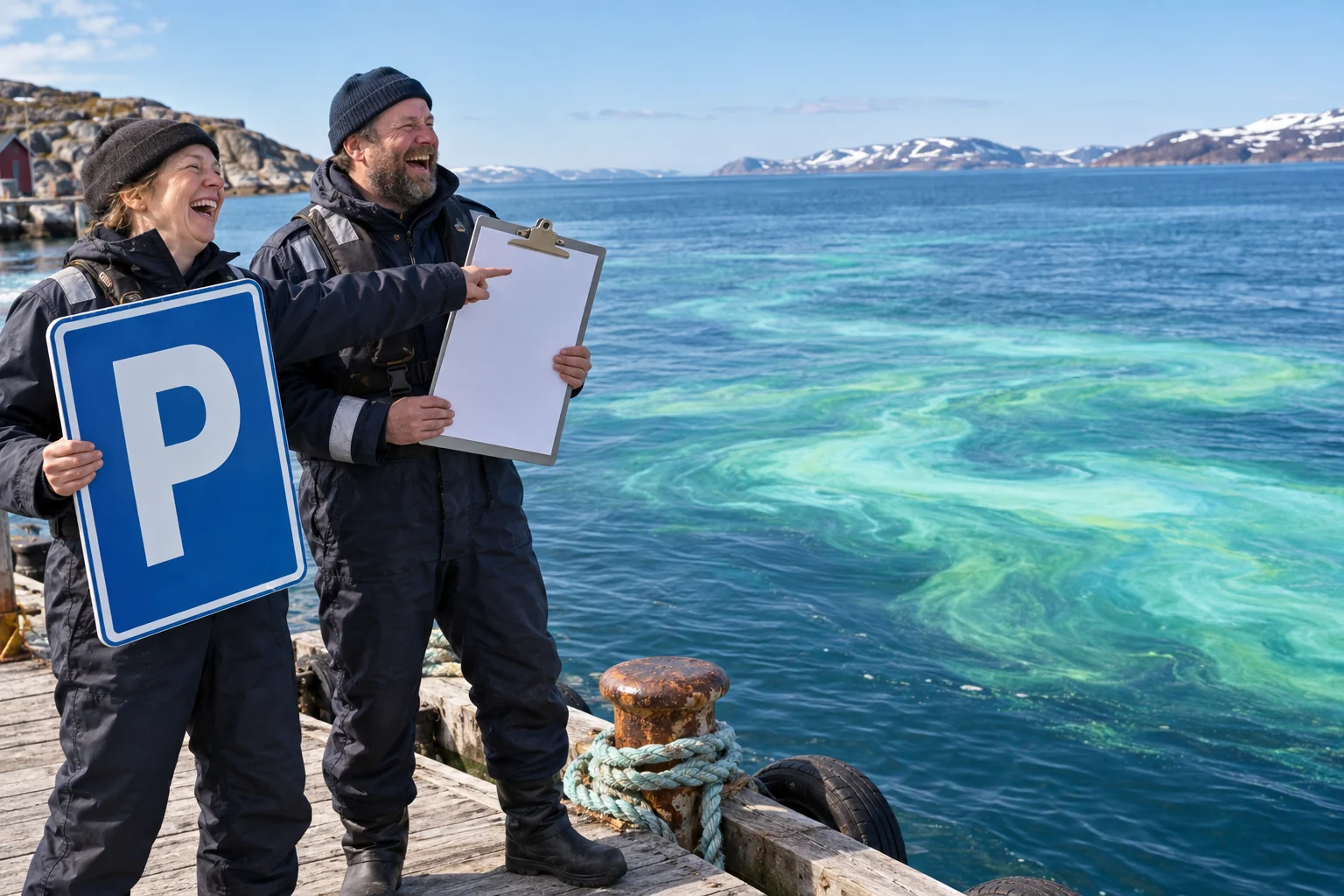
The Barents Sea bloom arrived near Bear Island in summer 2025, spread across the water, and immediately encountered the one force capable of stopping anything in the Arctic: an authority demanding to know where it intended to park. The microscopic organisms had formed naturally. The paperwork had not.

Barents Sea bloom faces a berthing instruction
NASA’s Aqua satellite captured the summer 2025 bloom on 5 August with its MODIS instrument. The bloom swirled around Bear Island while the fictional Arctic Navigation Authority prepared an emergency meeting about its failure to remain in one place.
Authority officer Dora Swatch opened a file labelled “Temporary Berthing Arrangement for Unscheduled Microscopic Occupants”. She reportedly asked whether the bloom could provide a vessel name, estimated departure time and a responsible adult. The bloom continued moving, which the authority recorded as “noncompliance with the spirit of parking”.
The Barents Sea bloom likely included coccolithophores, whose reflective calcium carbonate plates can give the water its milky turquoise appearance. Other phytoplankton and floating sediment can contribute different colours. None had applied for a berth, largely because a microscopic organism has better things to do than queue beside a harbour office.
The Arctic parking system finds a moving target
Phytoplankton feed small zooplankton and fish, underpin marine food webs and play a critical role in the global carbon cycle. This made the authority’s response especially useful as a demonstration of institutional priorities. A living system was supporting an entire ecosystem, while officials concentrated on whether it had occupied the correct imaginary bay.
Basil Keel, Chief Executive of Useful Ocean Watching, advised the authority to observe the bloom and leave it alone. The authority accepted this advice, created a three month consultation period, and sent the bloom a form asking it to confirm that it had received the advice. The form sank before delivery.
The parking permit was eventually approved in principle, subject to a fixed location, a signed arrival notice and proof that the applicant would not drift. By then, the Barents Sea bloom had moved on. The authority issued it a ticket for leaving its parking space before anyone had managed to find it.
Source: NASA Earth Observatory.