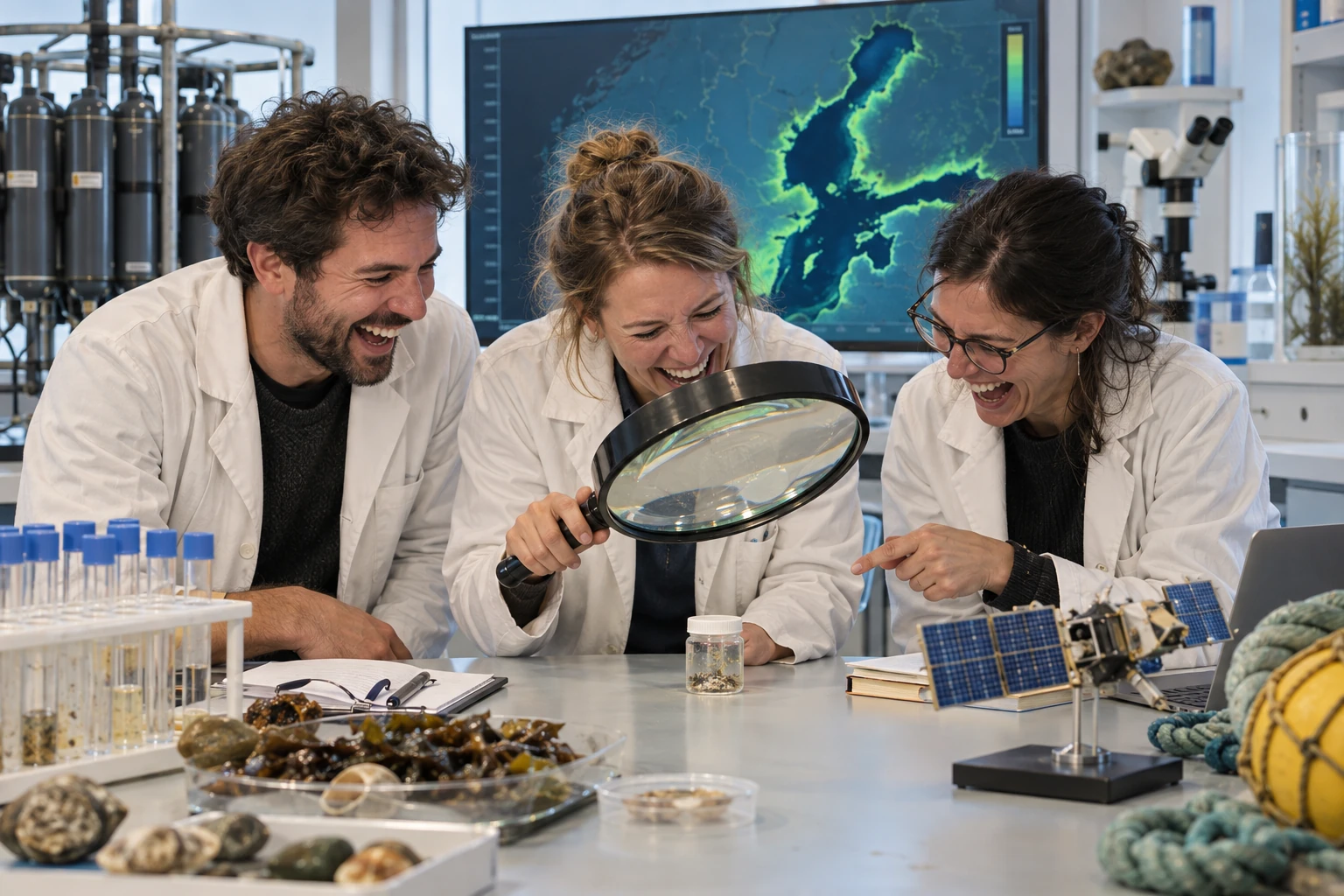
Bright green patches have appeared across the Baltic Sea, leaving humanity to confront its most frightening possibility: a natural phenomenon that cannot be identified within the length of a television bulletin.
Landsat 9 photographed the bloom on 20 July 2025, south of Sweden’s Gotland and southeast of Stockholm. The image shows phytoplankton swirling through the water in a shade usually achieved by a smoothie bar after discovering the word branding.
The satellite can show where the bloom is. It cannot, from those images alone, identify precisely which microscopic organisms are responsible. This has been treated by the Department of Instant Conclusions as a serious technological oversight. Officials have asked why a machine capable of photographing an entire stretch of sea cannot also lean down, take a sample and demand that the microbes complete a form explaining themselves.
In the real world, experts from the Swedish Meteorological and Hydrological Institute reported cyanobacteria in the surface waters that day. Suspended sediment and pollen may also have contributed to parts of the yellow green colour. The sea, having been presented with several plausible explanations, has declined to nominate one as its official spokesperson.
“Green indicates a lively situation,” said Doreen Tint, algae liaison at the Agency for Water That Has Been Noticed. “Consequently, we have given the Baltic a swatch book and asked it to stop improvising.”
Summer blooms are familiar in the nutrient rich Baltic. They matter because cyanobacteria affect marine ecosystems, nutrient cycling, food webs and oxygen levels after the organisms are broken down. Scientists therefore need careful data, which is unfortunate for anyone hoping to turn a complicated ecological process into a confident caption before lunch.
Chief Observer of Little Things Felton Speck said the investigation would proceed at a pace appropriate to the evidence. “We have asked the microbes for comment,” he said. “They have not replied, although this may be because they are extremely small, extremely busy or already represented by someone with a stronger opinion.”
The satellite has filed its photographs, the scientists have retained their caution and the colour consultant has gone home to reorganise a drawer of teal. The Baltic, meanwhile, remains green enough to prove that nature can launch a rebrand without a meeting, a strategy document or anyone later claiming they had always supported the colour.
Real story: NASA Earth Observatory.