
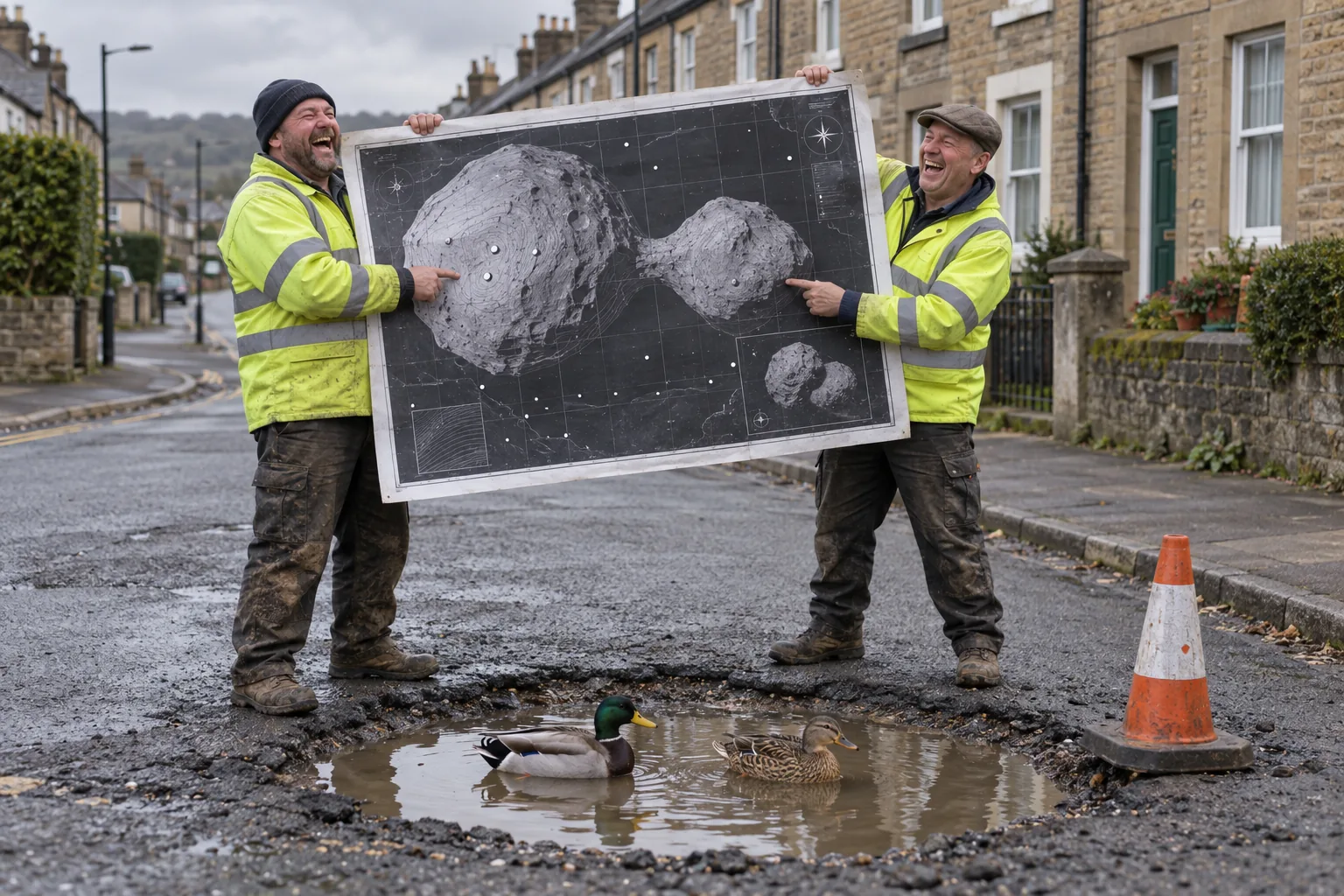
The International Astronomical Union has approved asteroid feature names for lobes, a neck and craters, proving humanity can organise a lump of rock in space before deciding whether the hole outside number 14 is infrastructure, wildlife habitat or a seasonal pond.
The names were approved for Donaldjohanson, the peanut shaped asteroid visited by NASA’s Lucy spacecraft on 20 April. The smaller lobe is Afar Lobus, the larger is Olduvai Lobus and the connecting neck is Windover Collum. Eleven features now have names linked to important discoveries and archaeological sites, giving a distant rock a more coherent address system than several new build estates.
The IAU also approved a coordinate system, allowing scientists to describe exactly where Lucy has been looking. Researchers can now direct one another to a particular region without resorting to “the smooth bit beside the larger lumpy bit”, a phrase most councils reserve for locating responsibility for a collapsed pavement.
“Naming creates scientific order,” said Dr Cosmo Kerbstone, Registrar of Remote Gravel. “We can identify a boulder on an asteroid with absolute precision. On Earth, we prefer residents to send three photographs, a ruler and proof that their wheel entered the pothole voluntarily.”
It also demonstrates what can happen when an organisation encounters a surface covered in holes and decides to solve the problem properly. The celestial approach involves observation, classification and a published map. The terrestrial approach involves a temporary traffic cone, a consultation and a second hole dug beside the first one to investigate the original.
As of 9 September, Lucy was nearly 300 million miles from the Sun and travelling towards its first Trojan asteroid encounter, expected in 2027. The spacecraft was continuing without a recent trajectory correction, unlike a commuter attempting to avoid the B347 after rain.
Scientists will keep monitoring Lucy as it travels into cooler space. Back on Earth, the local crater has acquired water, two ducks and a community Facebook group arguing over whether it lowers house prices.
The road authority has promised to give the pothole an official name. It will be called Windover Council, because once a hole has a proper name, the council can declare it a heritage feature and stop pretending repair was ever the plan.
Real story: NASA.