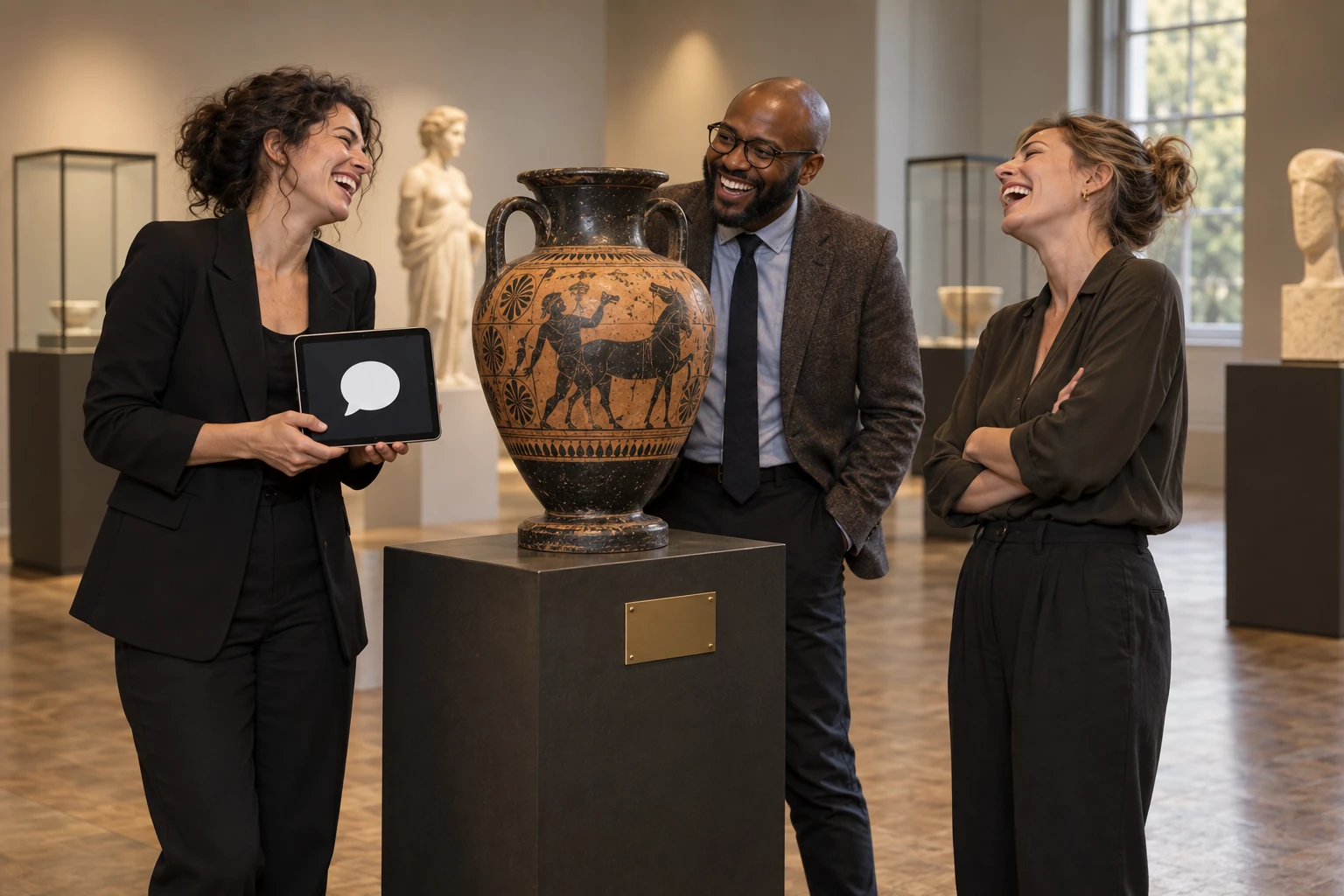
UNESCO brought museum leaders and AI developers together to discuss how technology might transform the way we experience shared heritage. The ancient vase has asked whether anyone considered leaving it alone, since it has already survived two thousand years without a chatbot, a user journey or a personalised content strategy.
The discussion took place during UNESCO’s General Conference, with museum professionals and technology specialists considering how artificial intelligence might support preservation, access and public engagement. This is a serious conversation. It is also the sort of conversation that ends with an artefact being told it needs to become more interactive.
The fictional Ministry of Interactive Labels, a department with a genuine fear of silence, has recommended that every object greet visitors with “How can I help?” The vase has submitted a collective objection on behalf of ceramics, sculpture and the entire pre digital world.
Dotty Plinth, the fictional Director of Things Behind Glass, said that technology could help people explore collections, but warned against asking a Bronze Age spoon to optimise its personal brand. She then watched a tablet describe a damaged amphora as “a bold conversation with absence” and switched it off with the calm of someone who had just seen a museum gift shop achieve sentience.
AI may help museums restore objects, digitise fragile collections and make exhibitions more accessible. It may also encourage institutions to confuse access with constant activity. A visitor standing quietly in front of an ancient work is apparently no longer having an experience unless a screen offers to summarise it in three bullet points and request a satisfaction score.
The fictional Office of Digital Wonder has proposed that every exhibit should have a chatbot, a feedback loop and a loading wheel. The vase has declined all three. It points out that the loading wheel has existed for less time than the civilisation that made it, yet already behaves as if it owns the building.
There is a real question about using AI without flattening history, overwriting oral traditions or replacing expertise with confident autocomplete. The human museum worker remains essential, particularly the one who says, “Please do not touch that,” before an app turns the warning into a suggested challenge.
At the end of the pilot, the vase was asked whether the new digital experience had improved its wellbeing. It remained silent, which the system recorded as its first successful public engagement metric. The museum then congratulated itself for finally making an ancient object speak, just before asking whether it would like to complete a survey.
Source: UNESCO.