Britain has announced up to £60 million for two new AI research labs, proving that the country is ready to invest in the future, provided the future can first complete the correct funding form and attach a sufficiently optimistic impact statement.
On 23 June 2026, the Department for Science, Innovation and Technology and UK Research and Innovation announced that labs led by Oxford and University College London would share the money over six years. They will also receive access to large scale computing power, because the first step towards making AI cheaper is apparently an electricity bill capable of frightening a university finance director into a new career.
The labs are intended to make AI more reliable, more efficient and easier for businesses, researchers and public services to use. One will develop open source systems that can run on widely available hardware. The other will explore ways for AI to learn more efficiently and adapt to new situations. The machines are being asked to become practical while the institutions describing them continue to communicate in language that may require a second machine to interpret.
The Oxford led British Open ended Learning and Discovery lab will work with UCL and Imperial College London. The UCL led Science of Fundamental AI Research lab will involve Cambridge, Oxford and Edinburgh. That gives the project enough world class universities to form a ceremonial procession, with every participant carrying a different definition of “transformative” and nobody carrying the plug.
The announcement says the investment grew from an earlier plan for one lab and £40 million to two labs and up to £60 million. This is a welcome expansion. The robot has asked whether the extra £20 million includes extra biscuits, or merely a larger spreadsheet explaining why biscuits remain strategically premature.
Up to £2 million for doctoral recruitment at each lab will help bring in at least 10 students. The rest will support research into systems that may eventually make advanced technology cheaper and more accessible. The robot has volunteered to supervise the first experiment, which involves teaching a printer to recognise the phrase “out of office”. It considers this a more realistic test of machine intelligence than asking a government website to explain a grant.
There is a serious point beneath the ceremony. Britain is backing fundamental research rather than promising that a chatbot will personally repair every public service by Friday. Yet after announcing an AI strategy worth £1.6 billion, the Government may soon need an AI system capable of locating all the announcements about locating things.
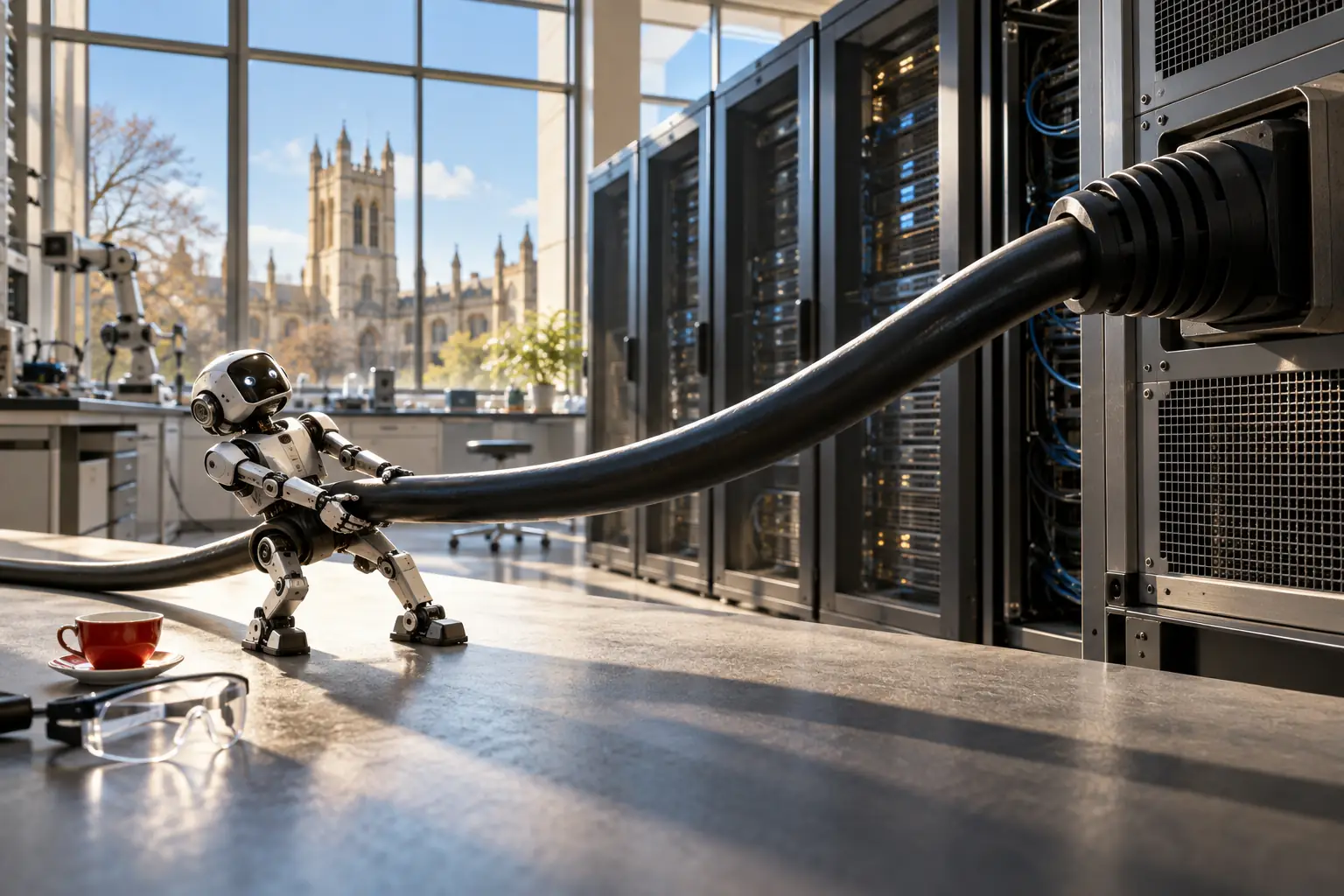
For now, the labs have funding, computing power and a national mission. The robot has a mug, a charging cable and a final theory. “Large scale compute” is what humans call a kettle when they want the Treasury to pay for it, and the kettle is the only machine in the building that has already delivered results.
Source: GOV.UK.