Police forces have unveiled a breakthrough system for completing missing ethnicity data by having an officer look at a person and decide what they probably are.
Missing Ethnicity Data, Solved
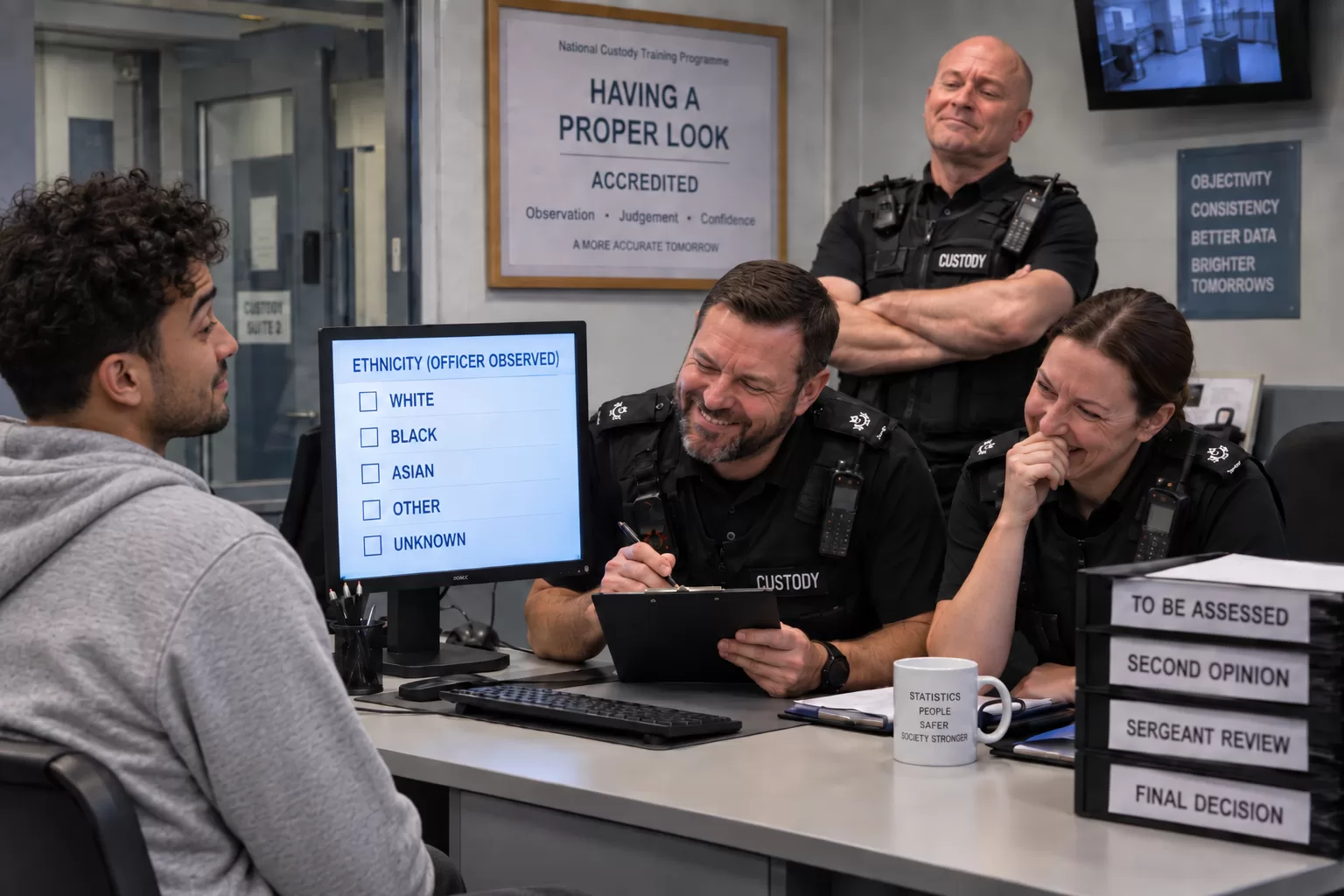
Officials introduced the National Visual Heritage Assessment Framework after they discovered that asking people to define their own ethnicity could produce complicated answers containing words, whereas looking at them produced a drop down menu.
Under the procedure, officers choose from White, Black, Asian, Other or Unknown.
The computer offers no mixed ethnicity option because it has only five buttons. One is already reserved for Unknown.
The Nine Minute Qualification
Staff qualify as accredited Ethnicity Observation Practitioners after completing a nine minute online module entitled Having A Proper Look.
Training includes facial observation, professional squinting and resisting the temptation to say “Mediterranean?” out loud.
“Identity can involve generations of family history, migration, culture, nationality and personal experience,” explained Neville Crimp, Director of Human Categorisation at the Office for Administrative Certainty.
“Our officers therefore receive almost ten minutes.”
When the Spreadsheet Needs a Second Opinion
Where the initial officer is unsure, a second officer moves the detainee beneath brighter lighting and has another look.
If both officers disagree, a custody sergeant performs a Senior Ethnicity Determination, which mainly involves folding his arms.
The Regional Appearance Panel handles particularly difficult cases. Three experienced officers stand behind a Perspex screen and quietly say things like “Could be Other” until a majority emerges.
The system also includes rigorous quality assurance.
An independent officer will check five per cent of classifications. They have never met the first officer, ensuring the second guess is completely impartial.
A new digital tool, RaceMate Pro, is also being trialled. Officers enter hair colour, complexion and “general vibe” before the software produces a classification alongside a confidence score ranging from Certain to Probably to Ask Darren.
Officials insist the system changes nobody’s identity.
“You remain exactly who you say you are,” said Crimp.
“You’re just something considerably easier in Excel.”
People who believe officers classified them incorrectly may request a review. They complete Form ETH 14, supply two proofs of address and attend in person so another officer can have a look.
The Office stressed that the system exists solely to improve the accuracy of statistics.
Early results show it has been remarkably successful at ensuring that everybody ends up being something.