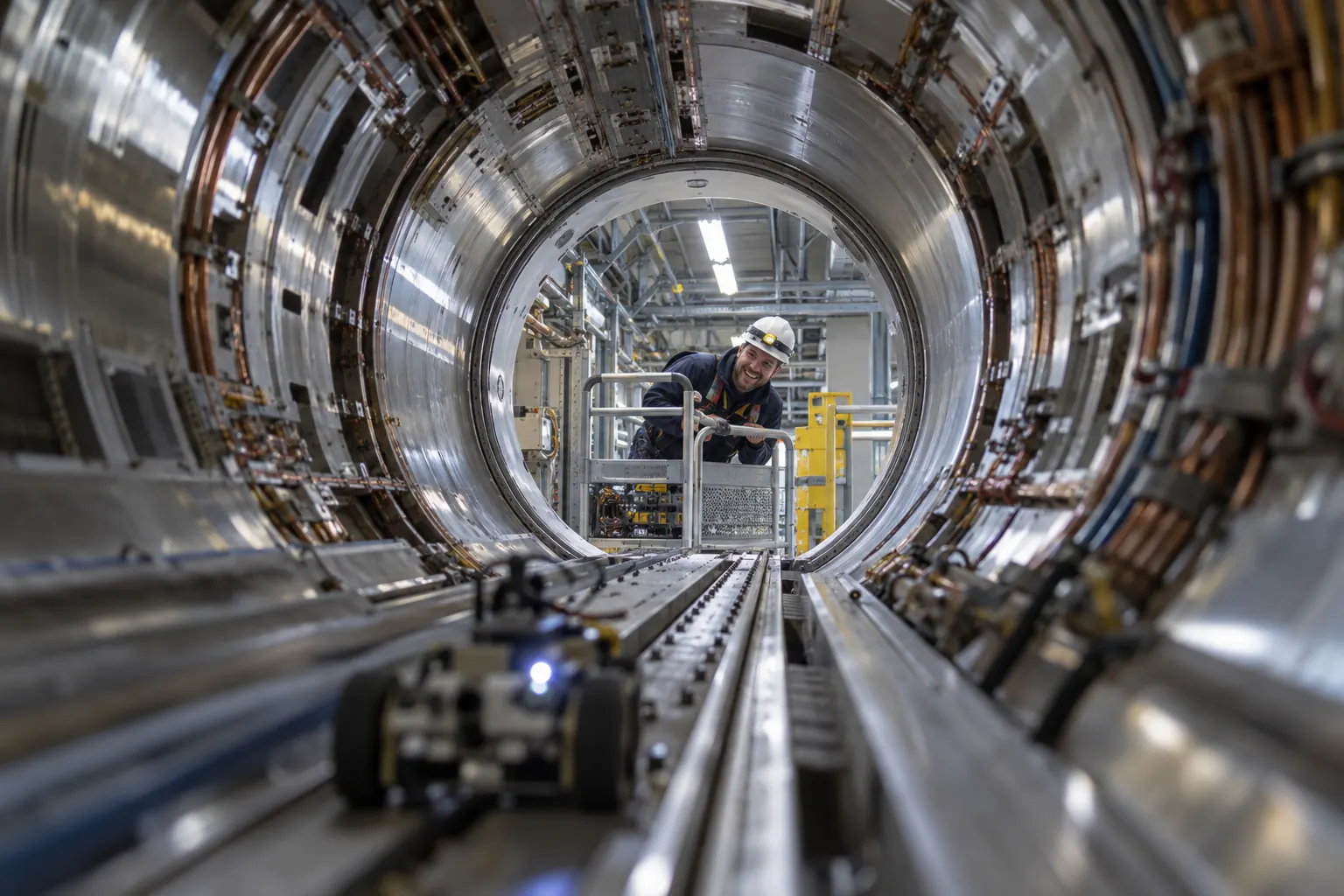
Robotic mice will inspect the Large Hadron Collider. At last, Britain has found pest control that can discuss particle physics without losing eye contact.
The mouse sized robot is called PipeINEER, a name formed from pipe and pioneer because even tiny machines must arrive with a professional biography. UKAEA and CERN developed it to inspect the LHC’s long, narrow beamlines. It can fit through spaces measuring 3.7 centimetres by 3.7 centimetres, making the world’s most powerful particle accelerator the proud employer of someone smaller than a respectable sandwich.
The LHC stretches for 27 kilometres, which is too far for most humans to inspect by crawling around with a torch and a packet of biscuits. PipeINEER can travel up to 6 kilometres on one battery powered mission, presumably while enjoying a healthier work life balance than the people supervising it.
The beamlines operate in ultra high vacuum beside superconducting magnets kept at about minus 271°C. This is not a workplace where an employee can pop out for a coat, a cup of tea or a brief discussion about whether the corridor is technically a corridor. PipeINEER has been designed for the sort of environment where a tiny obstruction can create a very large scientific headache.
Its cameras inspect Plug In Modules while artificial intelligence trained on LHC imagery looks for abnormalities. If the robot finds a problem, it returns to its starting point and reports the location. This saves engineers from dismantling large sections of pipe or sending a manual endoscope into the universe’s least welcoming service tunnel.
The project has been highly commended in The Engineer’s Collaborate to Innovate Awards, proving that international scientific collaboration can produce a machine which resembles a mouse and receives praise before completing its development testing. Further testing is planned for later in 2026, with final units and operator training planned for 2027.
It is a sensible use of robotics, fusion expertise and artificial intelligence. It is also a very British arrangement: give the most complicated machine on Earth a helper the size of a walnut, then wait for the maintenance meeting to discover that the smallest employee has the clearest career prospects.
Source: UK Atomic Energy Authority.