
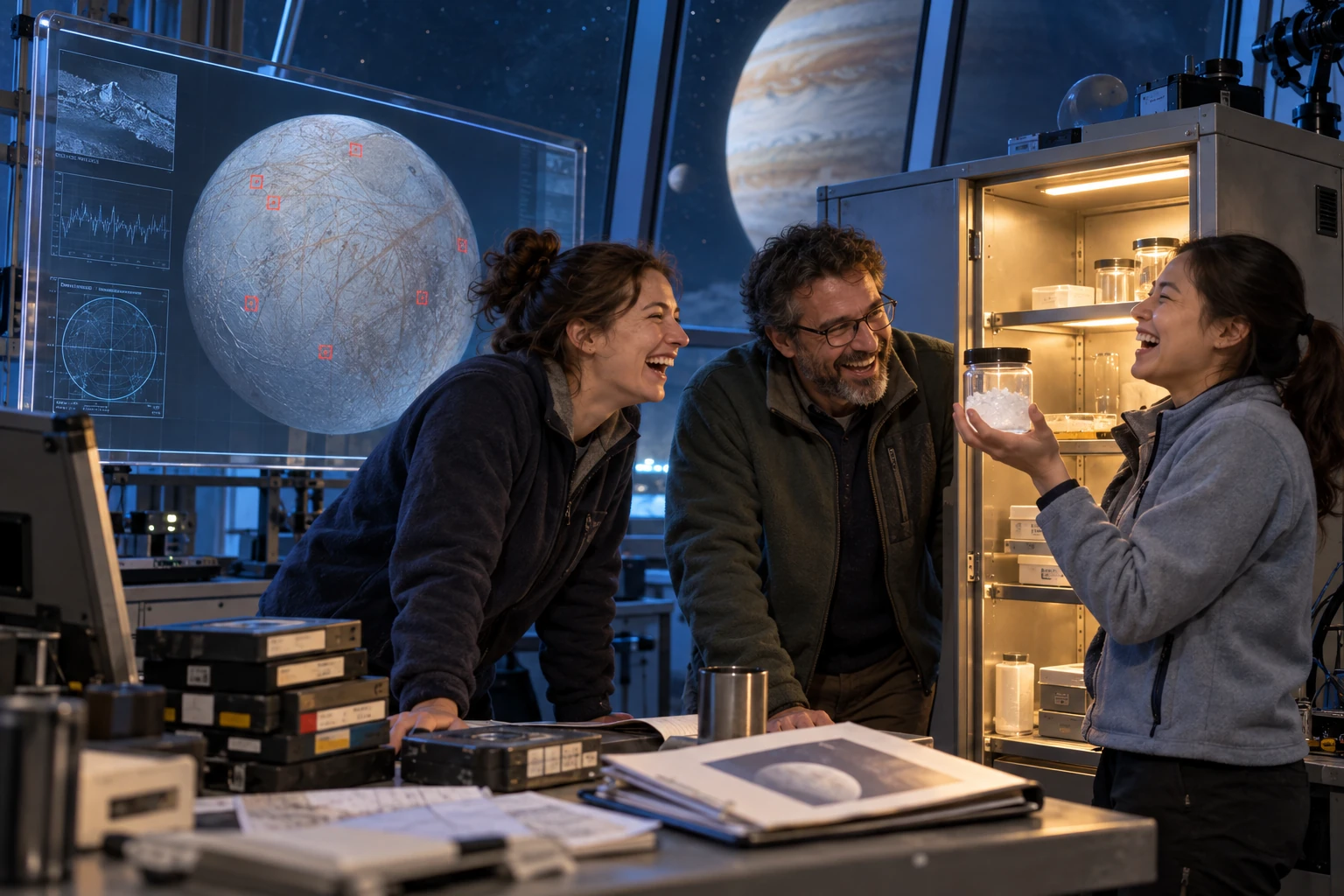
Europa has been caught with ammonia in the cupboard, although Jupiter’s icy moon insists the chemical was already there and that everyone should stop making a fuss about the smell.
A new analysis of data collected by NASA’s Galileo spacecraft has found ammonia bearing compounds on Europa’s surface. The signals were hiding in observations gathered between 1995 and 2003, proving that even a space mission can leave behind paperwork which becomes interesting decades after everyone has stopped checking the filing cabinet.
Ammonia matters because nitrogen is one of the elements important to life as we know it. This does not mean Europa is preparing a menu, opening a café or quietly breeding accountants beneath its ice. It means scientists have gained a useful clue about the chemistry of a moon whose most revealing feature remains its refusal to explain itself.
The compounds appeared near fractures and pits on Europa’s frozen surface. Researchers say they may have risen from below, possibly through recent cryovolcanism. At the Bureau of Old Space Receipts, analyst Mavis Spectrometer said the finding showed why nobody should throw away a mission file. “It may contain ammonia, history or somebody’s lunch,” she said, while labelling a cassette marked probably nothing important.
Ammonia also lowers the freezing point of water, acting as a kind of antifreeze. Its presence near cracks and pits gives scientists another reason to examine what may be happening beneath Europa’s ice shell. The moon is believed to contain a vast subsurface ocean, though it has yet to provide a statement confirming this and appears to prefer leaking evidence through the floor.
The discovery does not prove that Europa contains life. It does strengthen the case for studying its chemistry and gives the Europa Clipper mission another target when it reaches the Jupiter system in 2030. Clipper will arrive with instruments, schedules and the uncomfortable knowledge that Europa has already hidden important evidence once.
Professor Clive Icebox of the Department of Planetary Snooping welcomed the result. “The universe rewards patience,” he said. “It also rewards keeping every cable, receipt and spacecraft measurement in a box marked useful someday.”
Scientists now have a better question, which is often the most expensive outcome of research. Europa’s cupboard remains locked, but NASA has found the smell, identified the likely crack and booked a return visit. The moon’s defence is that technically, the cupboard is an ocean, so humanity has once again mistaken a geological mystery for a storage problem.
Source: NASA Science.