The government has launched a review of the BBC’s Royal Charter, inviting Britain to debate governance, funding and public trust before anyone asks who has hidden the remote. The broadcaster’s future is now a national consultation, which is encouraging because the public has been waiting years to explain what is wrong with the volume button.
Launched on 16 December, the review includes a Green Paper on the BBC’s public obligations, independence, funding and role in the creative economy. It is meant to shape the Charter that takes effect from 2028, assuming the nation can agree on a future before another streaming service changes its password policy.
The government says the BBC must remain trusted, represent communities across the UK and find sustainable funding. These are serious ambitions. They also create the rare policy document capable of moving from constitutional arrangements to minority language broadcasting while avoiding the urgent question of why every application now needs an account, a password and a small ceremony.
At the fictional Office of National Channel Hopping, policy usher Agnes Teletext welcomed the consultation. “A public broadcaster needs clear obligations,” she said. “It also needs a future in which every programme is not introduced by an app asking whether you are still watching.”
The Green Paper considers the licence fee, commercial income, the World Service and support for minority language broadcasting. It also asks how the BBC should respond to disinformation, digital change and artificial intelligence. The corporation is therefore being asked to protect the public from technology while using technology to explain the protection, probably through a portal that forgets your login halfway through the sentence.
The review considers regional growth, skills and jobs too. The BBC may soon be expected to produce trusted journalism, reflect the whole country, support the creative economy and make every economic strategy sound less like a laminated ambition. Nigel Jingle, another fictional contributor, said the process should be calm and evidence led. “People care about the BBC,” he said. “That is why every view must be heard, including the view that wants more regional news and the view that believes all regional news is an attack on the region.”
The consultation closes on 10 March. A White Paper is expected in 2026, followed by parliamentary debate before the current Charter expires in December 2027. There is plenty of time to consider the BBC’s future, provided nobody sits on the consultation form, loses the password or submits a detailed response through the television.
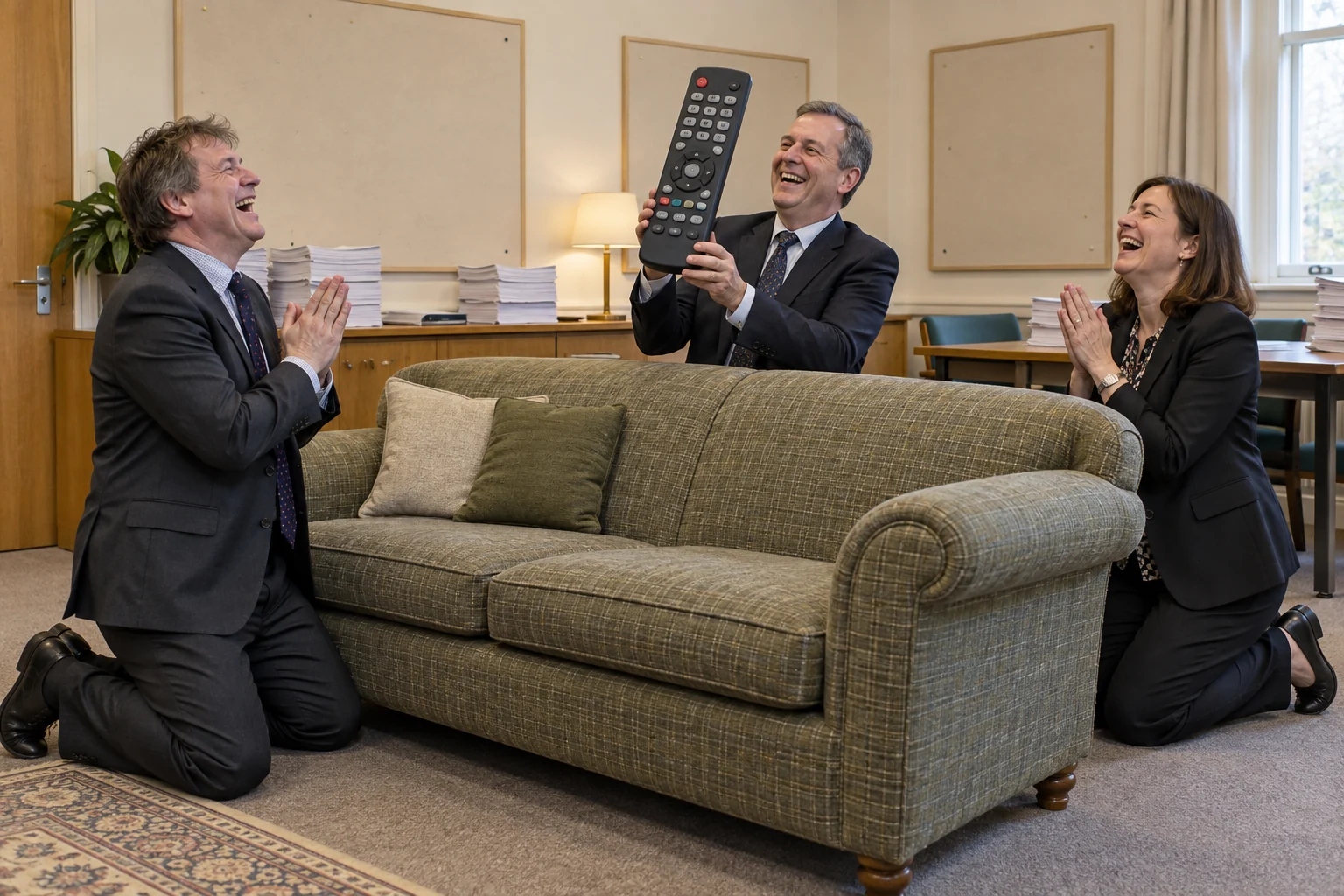
By 2028, Britain may have given the BBC a new constitutional settlement, a sustainable funding model and a clearer digital mission. The sofa will still have the remote. It will simply claim that withholding it is an independent public service, funded fairly by everyone and accountable to absolutely nobody.