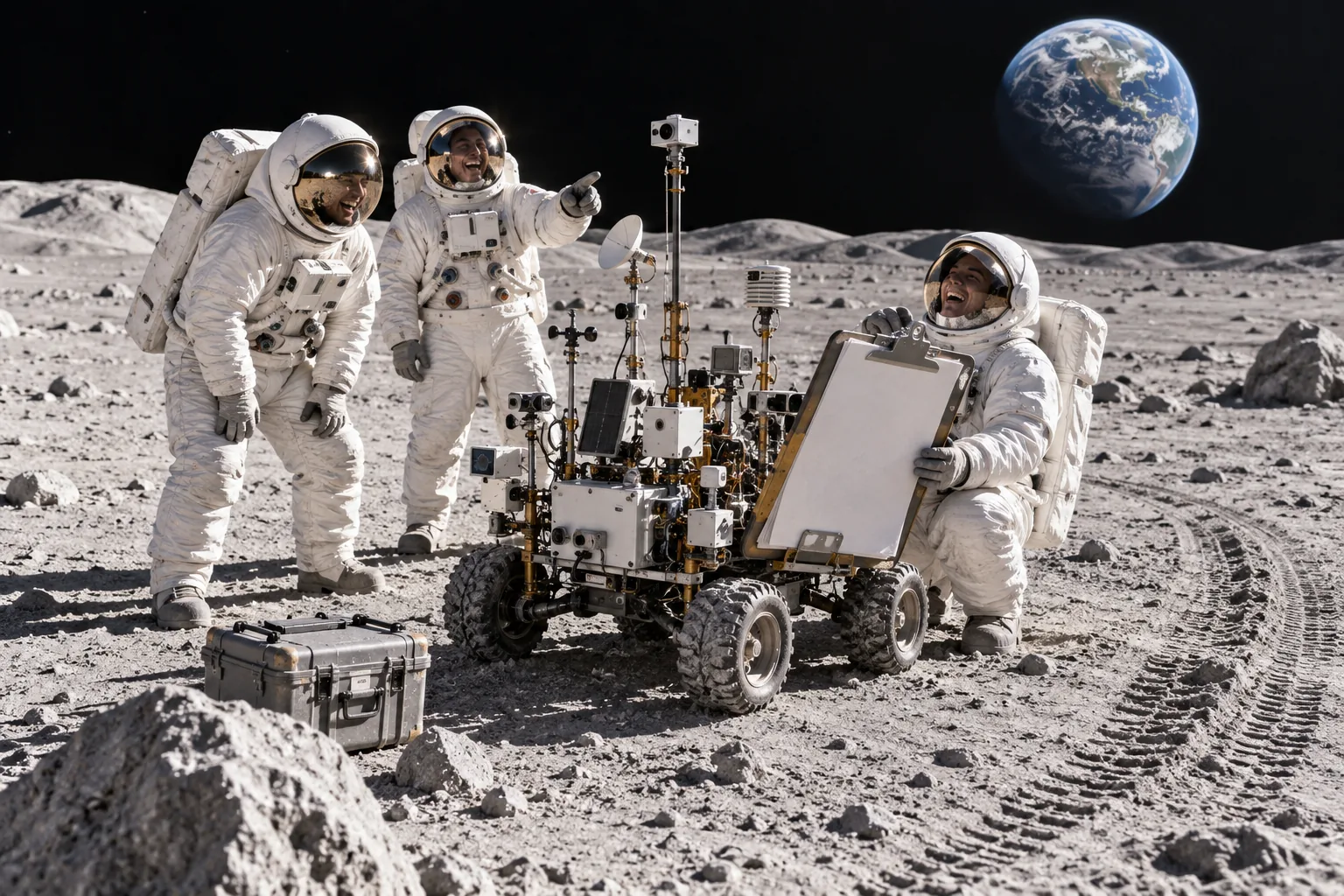
NASA has selected three scientific instruments for the Moon, including two intended for its Lunar Terrain Vehicle, turning the future buggy into a mobile laboratory with enough equipment to make the landscape feel obliged to produce a risk assessment.
The third instrument is intended for a future orbital opportunity, because even the Moon now requires a mixture of on site investigation and someone hovering above it with a clipboard. The vehicle is designed to carry up to two astronauts and operate remotely without a crew, giving NASA the choice of sending humans across the lunar surface or allowing the buggy to make its own decisions.
The Artemis Infrared Reflectance and Emission Spectrometer will map lunar minerals and volatile materials, including possible water, ammonia and carbon dioxide. The Lunar Microwave Active Passive Spectrometer will look beneath the surface, measuring underground structures and searching for possible ice more than 40 metres below ground. It is difficult to imagine a more serious way to ask whether the Moon has put anything useful in the cellar.
“We wanted a vehicle that could explore the Moon scientifically,” said Clementine Rake, NASA’s Deputy Administrator for Unreasonably Distant Parking. “Naturally, this involved fitting it with equipment capable of inspecting the entire lunar neighbourhood while still leaving room for two astronauts to ask whether that crater was definitely on the route.”
Together, the instruments will help scientists understand what the Moon is made of, where its resources might be and how its surface has changed. This is vital research. It also means the buggy may spend its working life examining ground that resembles an abandoned building site after the builders have taken the buildings away.
The orbital instrument will provide wider context for discoveries made by the vehicle, map lunar geology and help identify useful sites for astronauts to collect samples. It will also study how human activity affects lunar volatiles, which is a polite scientific way of asking whether we have already started leaving things everywhere.
The vehicle will be the first crew driven vehicle to operate on the Moon in more than 50 years. It can also be controlled from Earth, roughly 240,000 miles away, giving parking disputes a majestic delay while everyone involved waits for the crater to accept responsibility.
NASA has given the Moon instruments, a rover and a plan. The only missing item is a lunar surface confident enough to say it has read the instructions, signed the inventory and knows who authorised the clipboard.
Source: NASA.