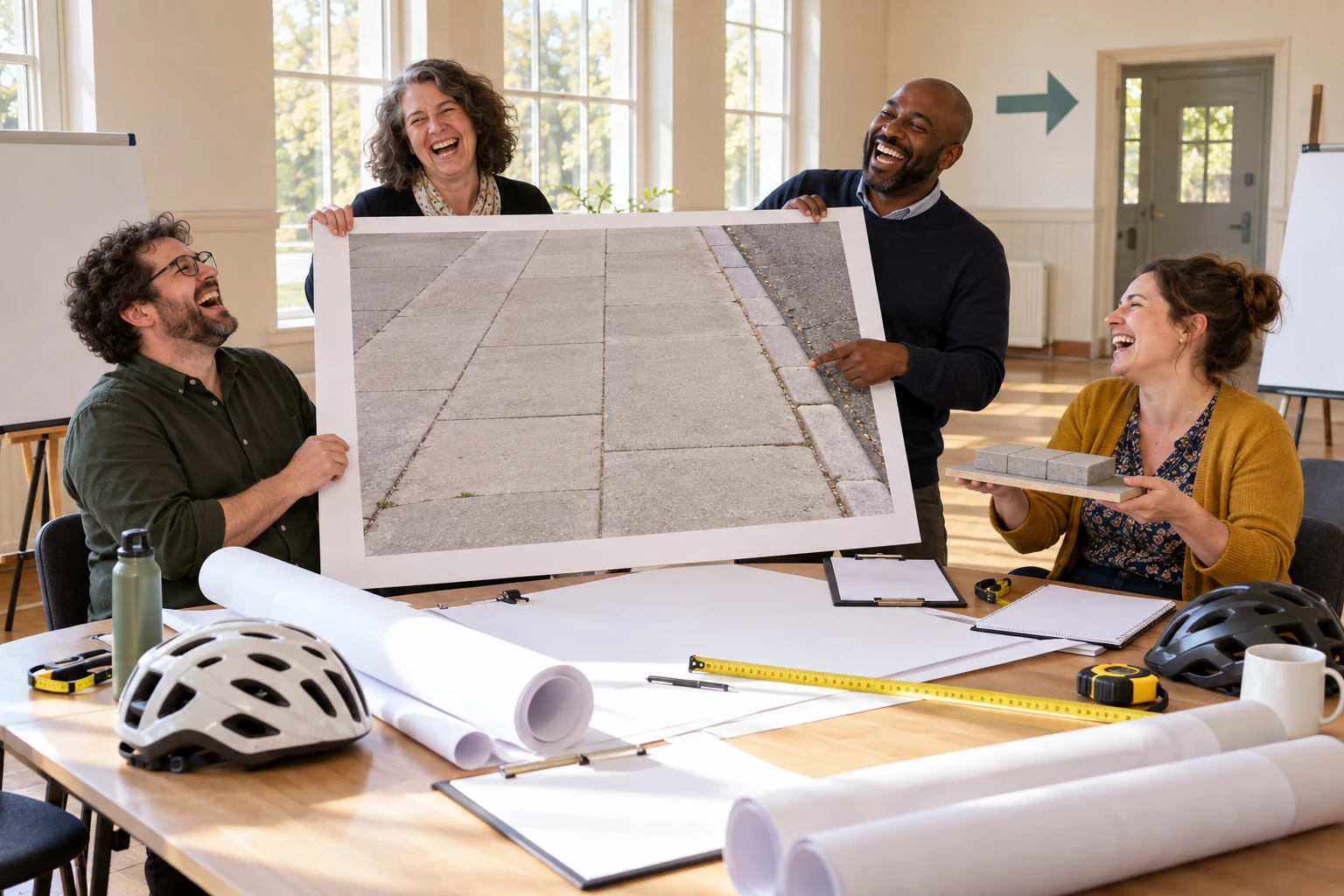
The Active Travel Fund is offering up to £100,000 for projects that help people walk, wheel or cycle. The application itself must apparently travel much further, carrying a case study, a stakeholder map and one anxious diagram proving that a pavement is not merely a road which forgot to grow.
Active Travel England has put £1 million into the competition, inviting small and medium sized businesses and non governmental organisations to submit ideas. These could help under represented groups make more active travel choices, bring councils and communities together, or use digital tools to improve safety and accessibility.
The practical aim is admirable. The paperwork is where the pavement acquires a personal development plan. A short journey must now demonstrate ambition, inclusion, creativity and a measurable theory of change before it can approach a dropped kerb without an appointment.
‘We seek bold proposals,’ said Pippa Pedalworth, Comptroller of Sensible Kerbs. ‘A project should be innovative enough to attract funding, but familiar enough to be recognised by everyone who has attended the same consultation since 2019.’
Successful projects can receive grants of up to £100,000 and support with partnerships, stakeholders and ways to measure success. The money runs for twelve months, after which each organisation must submit a case study and final report explaining what happened. The pavement will then be invited to reflect on its learning journey.
This is entirely reasonable. Public money needs evidence. A safer crossing should work, rather than merely appear in a photograph beside a high visibility waistcoat. But the modern project must also prove that it has engaged with users, funders and the people who were invited to a meeting about inviting people to a meeting.
The Bureau of Route Optimism has prepared performance measures for stronger local links and the number of residents who have stopped saying, ‘I would walk there, but’. It abandoned ‘general sense of improvement’ after discovering that the reporting portal only accepts outcomes which can be made nervous by a spreadsheet.
There is real value in finding out why short journeys do not happen. A missing dropped kerb is a physical barrier. So is a crossing that treats a pushchair, wheelchair or bicycle as an unexpected administrative complication. The challenge is to improve the route without burying it beneath a launch event, three logos and a laminated theory of movement.
At the final briefing, a pavement officer reached slide 14 of a presentation about making journeys easier. When slide 15 loaded, the audience applauded, completed an impact assessment and applied for funding to walk back to the exit.
Real story: Department for Transport and Active Travel England.