
Britain has announced plans for a £29.6 million RNA Biofoundry in Darlington, giving experimental medicine a route out of the laboratory and into the nation’s favourite industrial process: waiting for a meeting about delivery.
The planned facility will help researchers and businesses design and manufacture RNA materials for clinical trials. It will be based at CPI’s existing RNA Centre of Excellence, where promising treatments can presumably advance from “exciting possibility” to “please find attached the revised procurement timetable”.
RNA therapies can be designed quickly and adapted to different diseases. They may eventually help tackle cancer, heart conditions, infectious diseases and other serious illnesses. For now, their chief challenge is persuading a treatment that has survived years of research to survive the British journey from laboratory bench to approved product.
“We are scaling discovery,” said Dr Millie, Forewoman of Tiny Instructions. “The molecules are ready. The forms are only on page three of the forms.”
The Biofoundry is intended to provide specialist equipment and expertise for producing RNA at the clinical standard and scale needed for early trials. This addresses the expensive and complex problem of making enough material to test, rather than leaving valuable ideas trapped in a presentation about future progress.
It will also be able to switch to vaccine production if circumstances require it. The building has therefore been trained to expect a national emergency, a sudden request for speed and somebody asking whether the relevant approval can be copied to everyone.
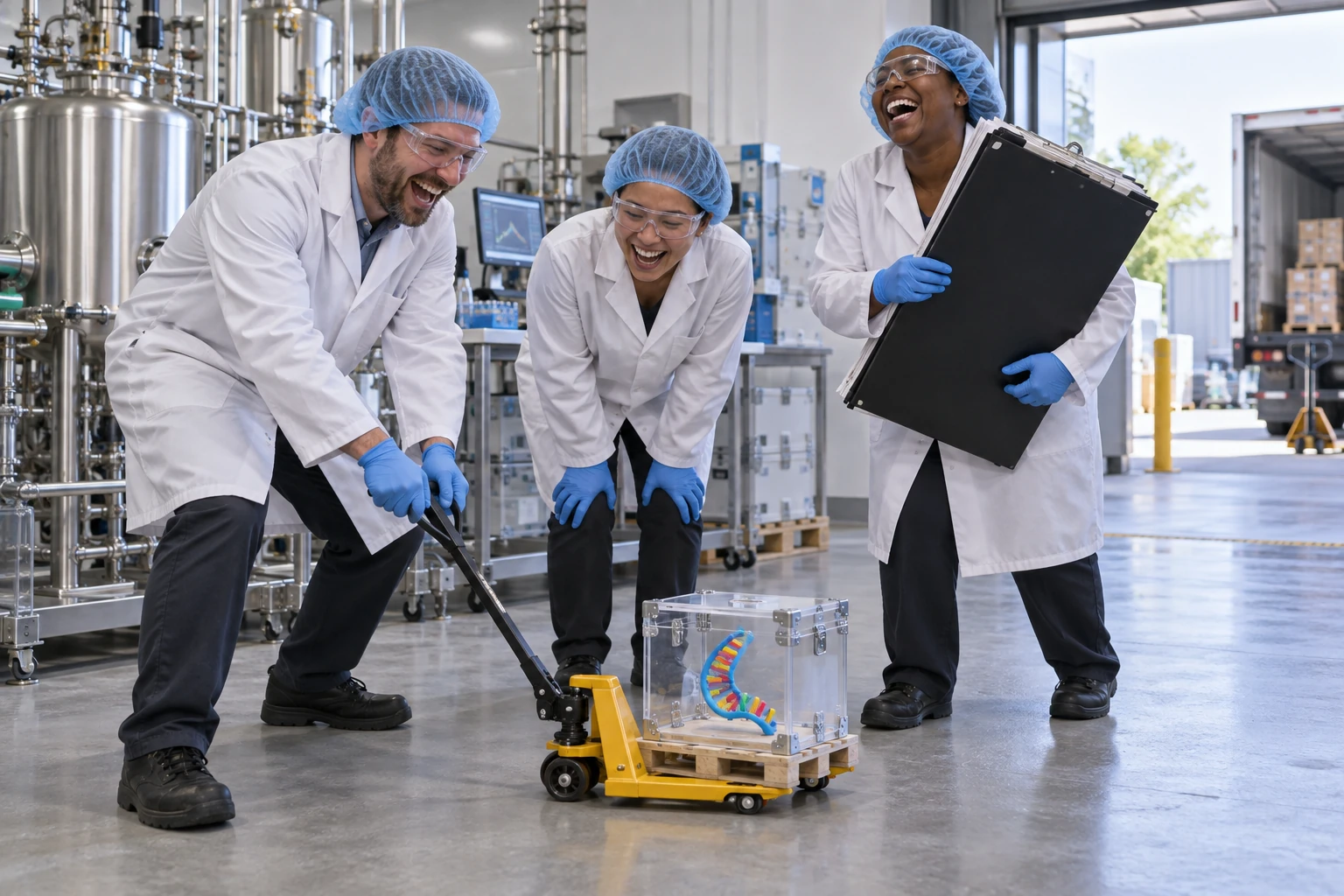
The language is suitably ambitious. The project is expected to accelerate healthcare, support the economy and help the North East lead the world, while the actual RNA will still have to pass extensive testing and evidence checks before anyone is allowed to put it in a person. “Fast tracked” means removing avoidable bottlenecks, not loading a pallet truck with unlicensed cures and aiming it at the NHS.
Science has received its loading bay. The next breakthrough is finding someone authorised to sign for it, preferably before the form confirming that the form has been received expires.
Real story: Department for Science, Innovation and Technology.