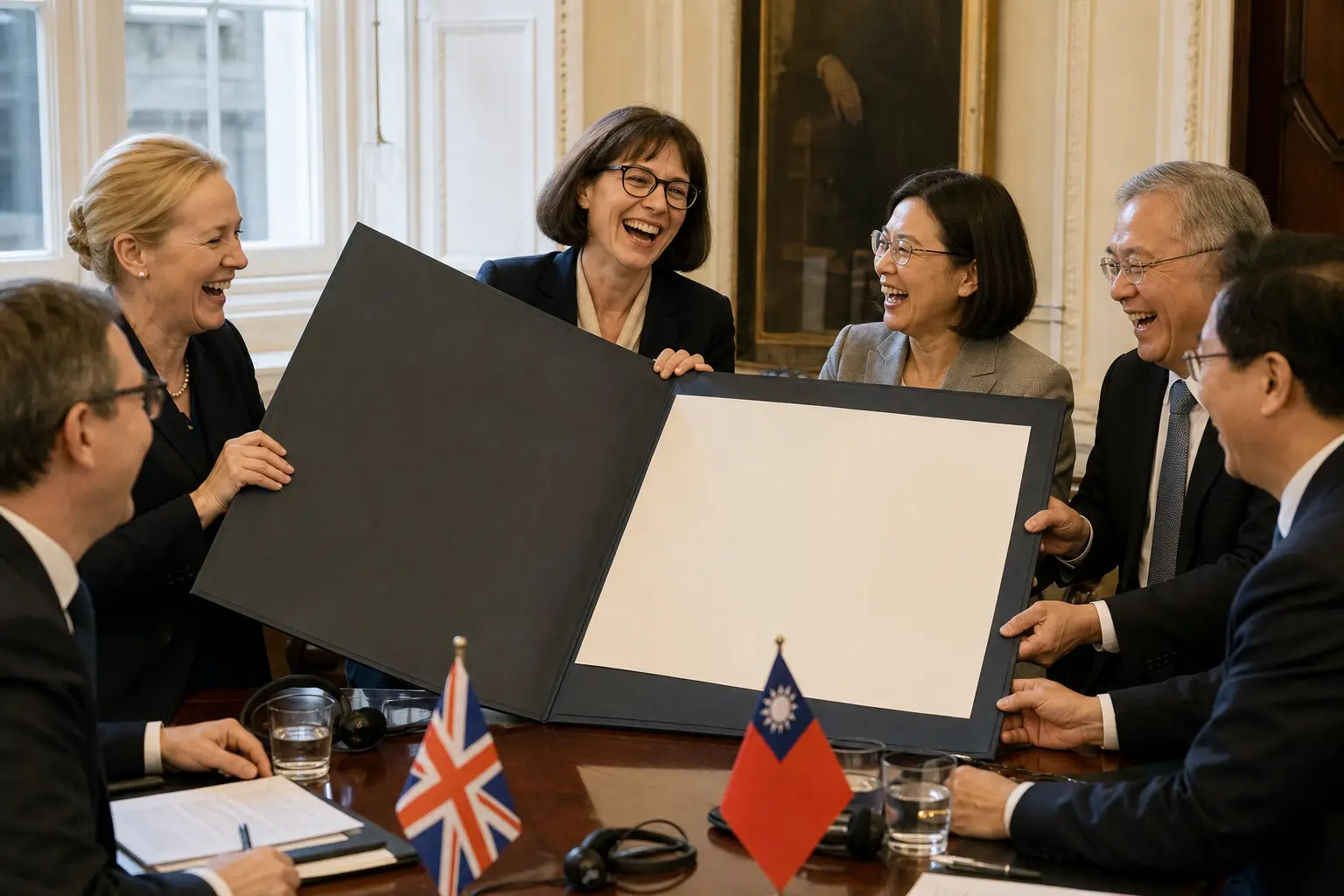
Clara Wainscot, Whitehall’s director of Grand Phrases, welcomes a framework so non legally binding that even its handshake comes with an escape route.
Britain and Taiwan held their 28th annual trade talks in London and launched a new Science, Innovation and Technology Arrangement alongside a Taiwanese business delegation. Clara Wainscot said the three nouns returned whenever progress became grammatically difficult.
The arrangement is non legally binding, so both sides can discuss semiconductors, space, telecommunications, net zero and AI standards without risking a promise that survives the room. Dr Miriam Quill, chief of the Office of Consequences Avoided, called it “a useful way to keep options alive, especially the option of denying one existed”.
The talks have been held annually since 1991. Taiwan was the UK’s sixth largest trading partner in the Asia Pacific region in 2025, with bilateral trade worth £8.9 billion. Edwin March, deputy head of the Unit for Ambitious Nouns, calculated that the figure was large enough for 28 meetings and vague enough to require another.
Minister for Trade Lord Sarwar and Taiwan’s Deputy Minister of Economic Affairs Cynthia Kiang co chaired discussions on trade and investment, digital trade, clean energy, advanced manufacturing and resilient supply chains. Clara Wainscot filed each topic under Science, Innovation and Technology, leaving responsibility off the agenda.
UK Export Finance and Taiwan EximBank also signed a memorandum to strengthen cooperation on export credit opportunities. Ruth Bradley Jones and Vincent Yao signed the papers, while the new arrangement was witnessed by Dr Dave Smith and Deputy Minister Bing Yu Chen. The documents made the occasion look organised.
Taiwanese businesses used the wider visit to strengthen commercial partnerships and explore investment. Whitehall preserved the three nouns. The most binding thing in the room was the stationery.
Source: Read the real story