Planning AI enters the cupboard of records
A new experimental planning AI can turn ancient council documents into usable data in about 40 seconds. That beats opening a PDF and discovering it faces sideways.
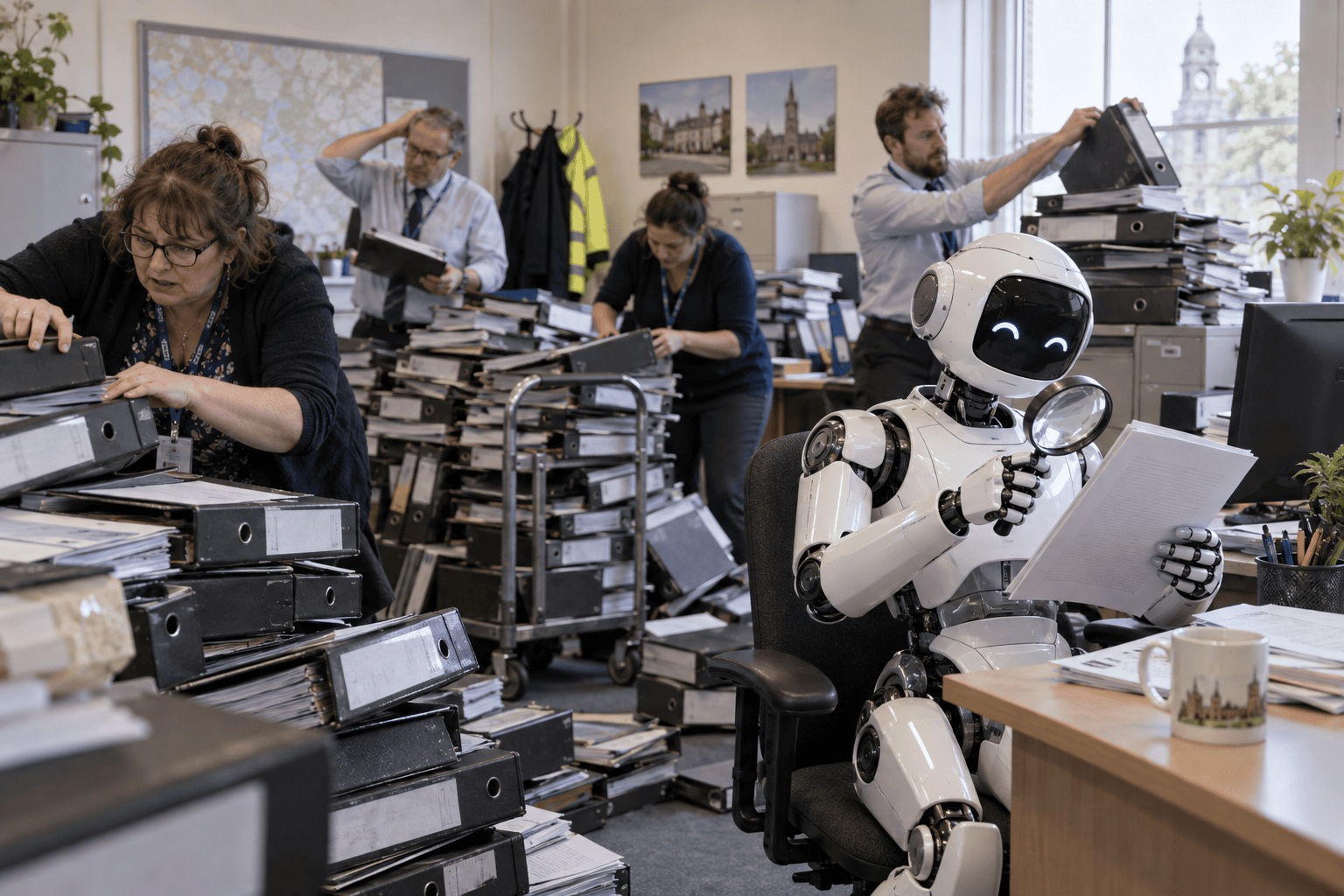
The team calls the tool Extract. It reads scans, old maps and handwritten notes. A planner might spend one or two hours on the same task. Meanwhile, the machine can finish before the office printer clears its throat.
Officials at the Ministry of Digitised Brown Envelopes tested it on a 1974 file. Someone had labelled the file FINAL_v2_ACTUAL_FINAL_USE_THIS. Extract found the boundaries immediately. Then it asked why somebody had photographed the annex through a sandwich bag.
“We smashed every benchmark,” said Dr Petunia Raster, Chief Smudge Interpreter. “Extract recognises faint pencil and obsolete typefaces. It even understands ‘see attached’ when the attachment vanished during the Heath government.”
However, planners still need human expertise. An algorithm may understand every line on a map. Only a professional can explain the consultation list for a modest loft conversion. Highways, drainage and archaeology all require a view. So does Derek, who left the council in 1998.
The technology promises quicker decisions and more homes. First it must survive the ultimate public-sector test. Somebody must approve its access to the folder it needs to read.
Read the real story: Experimental AI for digitising planning records.
Councils say the system will free staff for higher value work. This includes receiving the AI output, printing it, scanning the printout and asking whether the original could be emailed as a PDF for audit purposes. Extract has begun preparing its own planning application for a small shed in which to store the paperwork.