New planning rules give homes near stations a default yes, ensuring thousands of future residents will live close enough to public transport to hear why it is not running.
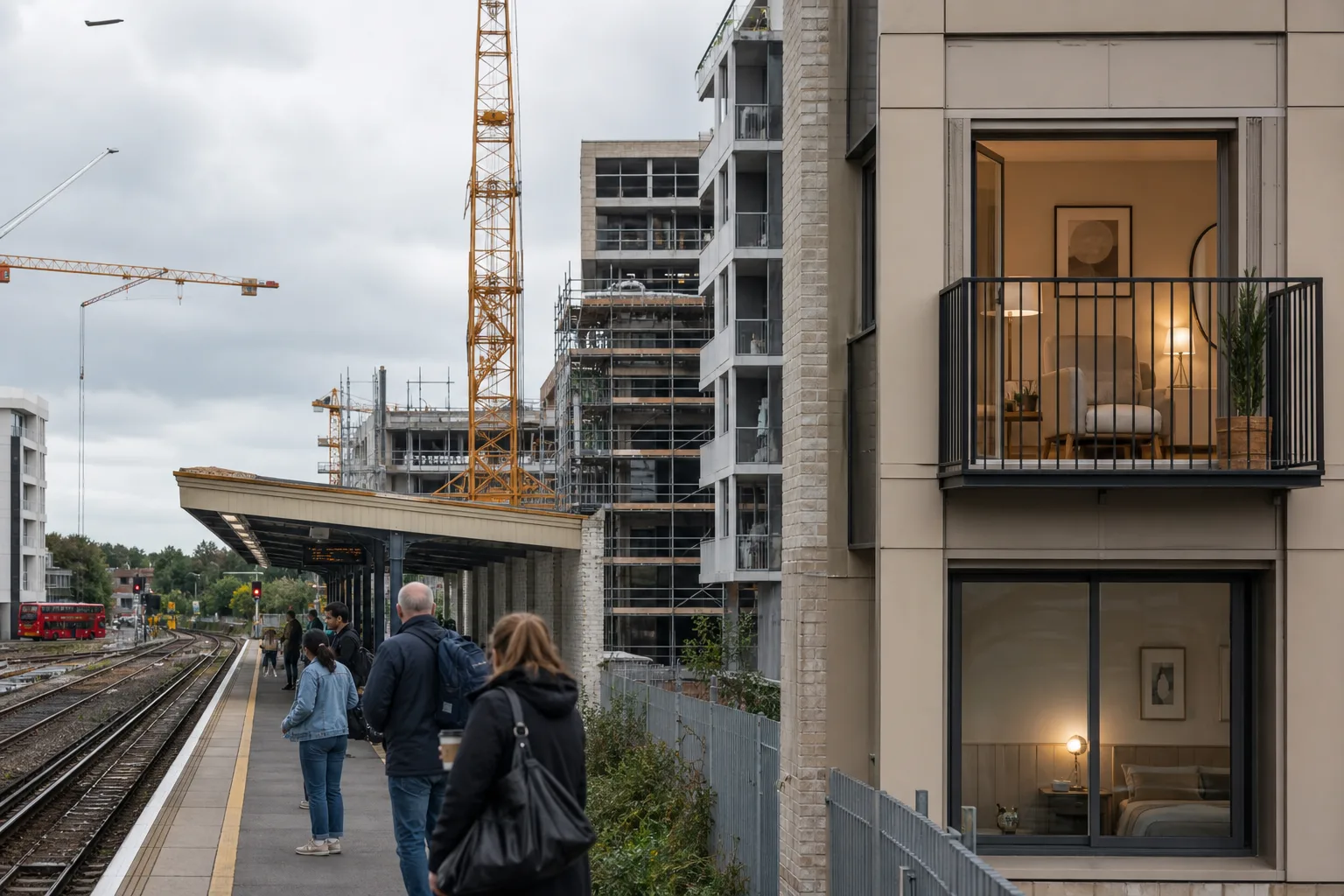
The government has announced a bold answer to the housing crisis: put it somewhere commuters already stand and stare into the middle distance. Its new planning rules support thousands of homes around England’s train, tram and Underground stations. Development within reasonable walking distance of a well-connected stop will receive a default “yes”.
This makes the railway platform Britain’s newest branch of the planning department. Please stand behind the yellow line while a medium-density neighbourhood passes through without stopping.
Homes near stations receive the default yes
Until now, planners asked whether a development suited its location. The new system begins with yes and works backwards until somebody finds a protected newt, an electricity substation or a local Facebook group with access to capital letters.
In The Lawn’s entirely fictional guidance, “reasonable walking distance” will be measured by an inspector carrying a flat white, a laptop bag and the last functioning umbrella in the public sector. The inspector walks away from the station until the coffee escapes through the lid. Everything inside the splash radius becomes a Mobility Quarter.
If residents can hear a platform apology from their kitchen, developers may add two storeys. If they can understand the apology, the site qualifies as exceptionally well connected. A replacement bus counts as mixed-mode transport, provided nobody asks where it goes.
Homes near stations meet luxury beige
The government also wants to stop excessive gold-plating where national standards already exist. Developers have confirmed that this will not affect the gold lettering used to describe a one-bedroom flat as The Residences at Signal Yard.
The wholly invented Department for Sensible Proximity has approved three finishes: Station Car Park Grey, Replacement Bus Magnolia and Signal Failure Taupe. The premium package includes a balcony wide enough for one resident, or two estate agents standing sideways.
Meanwhile, every kitchen will receive an “integrated transport outlook”. This is a window facing the departure board. Buyers who cannot see the board will receive a complimentary app that announces cancellations in a soothing shade of coral.
The serious bit arrives on platform two
There is real policy beneath the property brochure. The government says it has passed the quarter-way point towards its target of 1.5 million homes. Its reworked National Planning Policy Framework supports development in sustainable locations and sets minimum density expectations near stations. Major developments must also make at least 40 per cent of homes accessible.
Those commitments can be measured. However, the announcement cannot yet prove how many completed, affordable homes the reforms will produce. Nor can it establish whether local infrastructure will arrive before the rooftop yoga deck.
A community, conveniently delayed
The plan reaches beyond housing. The government says new development should bring people closer to work, schools and services. Its reforms also support shops, leisure facilities and community venues.
Accordingly, our entirely fictional model district contains a nursery, a dentist and an artisanal bakery selling the £7.40 Off-Peak Croissant. Its pub is called The Reasonable Walking Distance. Last orders occur whenever the licensing officer’s coffee lid fails.
Across the road, a sales suite labels the area North Platform Quarter, despite it being south of the platform and technically in a skip. A bowl of wooden pears represents access to fresh produce. A tiny bicycle in the architectural model represents the last person who could afford the service charge.
Mind the policy gap
Building homes near public transport is a practical idea. People need homes, and useful places need transport. Underused land does not have to remain a windswept memorial to faded parking bays and one trolley with a private life.
Still, the test is not whether ministers can place a confident “yes” on the timetable. Councils, builders, infrastructure and affordability must all reach the same platform. Until then, the housing crisis has merely moved from the pending tray to platform four, where it is delayed due to an earlier policy failure.