The NHS is creating one joint executive team to reduce duplication, because the most efficient way to remove two management structures is apparently to give their disappearance its own management structure.
The Department of Health and Social Care and NHS England announced on 18 September that a single joint executive team will provide leadership across both organisations as they move towards one organisation. From 3 November, directors covering related areas will be managed through shared arrangements, with the stated aim of aligning policy and delivery while cutting red tape.
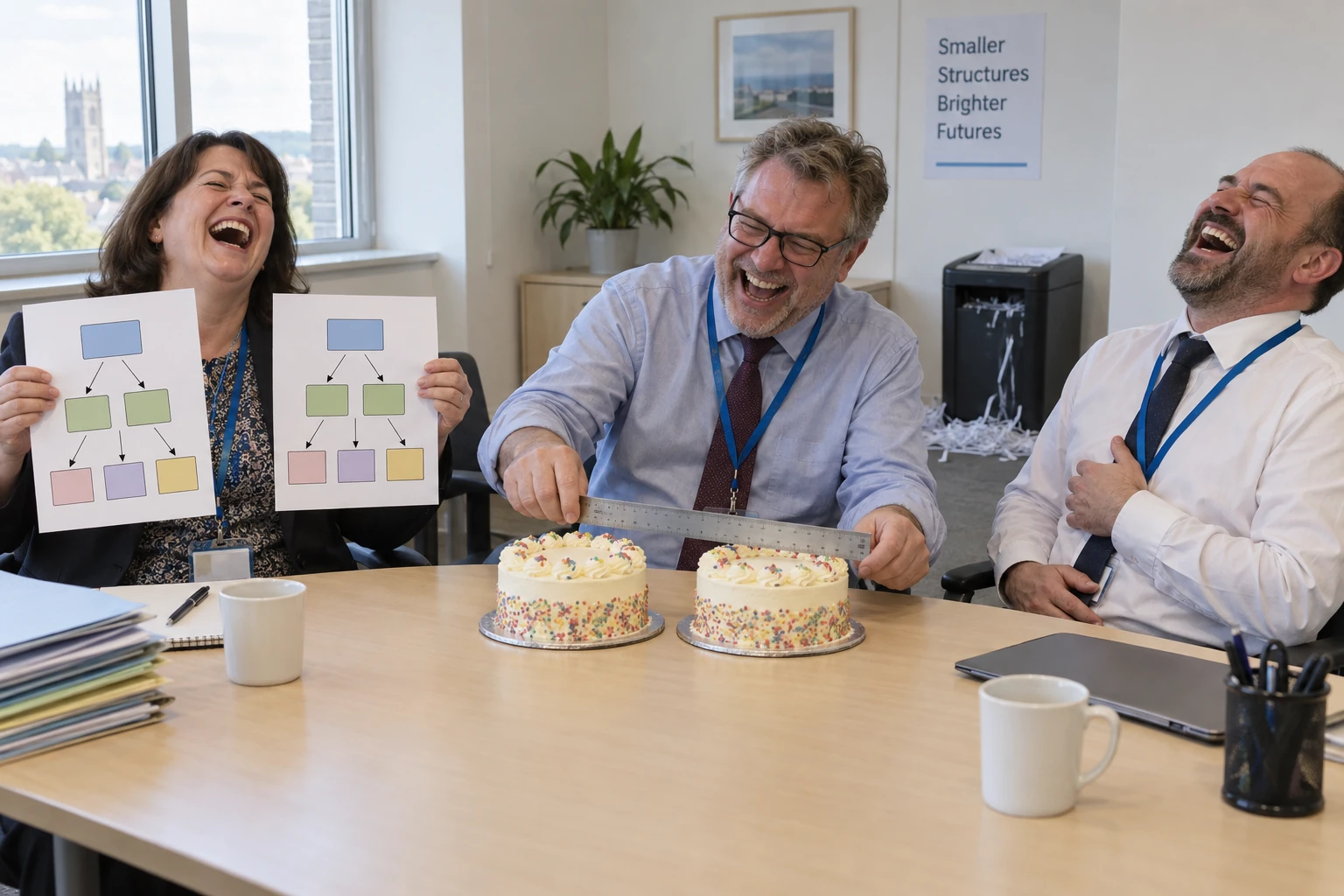
This is excellent news for anyone who has ever looked at two matching organisational charts and thought, “What these need is a third chart explaining the merger.” The new arrangement will bring together senior figures, regional teams and national priority programmes, united by the shared conviction that the previous structure was needlessly complicated.
The Authority for Organisational Simplification has welcomed the announcement from a room containing several smaller rooms. It has ordered a ceremonial shredder to remove duplicate organograms. The machine destroys one copy, scans the other and emails both to a transition board for review.
‘Patients need clarity,’ said Sir Digby, Interim Permanent Director of Arrows. ‘Every decision will now follow one clean line, seven dotted lines and Malcolm, who has been asked to explain the arrows.’
The official plan is to combine resources and bring policy and delivery closer together. That may eventually make accountability easier to follow. For now, the transition has the familiar quality of a sat nav recalculating while three people insist they know a better route.
Executives have agreed that duplication wastes time. Consequently, one agenda item will replace two identical agenda items. Both original teams must attend the meeting to confirm which one has been removed.
The Office of Lean Governance has promised fewer layers. Its recommendation passed through four assurance levels, returned sideways for branding and emerged as a landscape PDF named FINAL SIMPLIFIED V12 USE THIS ONE. A revised version is expected after someone checks whether one organisation requires a second cover page.
Frontline staff need decisions that arrive clearly, not merely reporting lines that look tidy from a distance. The joint team is therefore expected to spend its first weeks deciding who owns the responsibility for making the structure look less like a structure.
Leaders celebrated the end of parallel working at close of business. NHS England ordered a cake and DHSC ordered the same cake. The cake planning team has now formed a taskforce to merge them without creating a cake executive.
Real story: Department of Health and Social Care.